Episode 27 — All Four Engines Dead, 18 Minutes of Gliding, and a Safe Landing: The Miracle of British Airways Flight 9
On June 24, 1982, at 1:42 AM, a British Airways 747 was cruising at approximately 12,400 meters above the Java Sea when its engines began shutting down one by one. Engine One. Engine Two. Engine Three. Engine Four. All stopped. The aircraft, carrying 263 passengers and 23 crew members, hung silently in the sky with no thrust. And then the miracle began.
Airplanes Can Fly Even Without Engines
The reason an airplane stays in the sky is not because of its engines. Engines do nothing more than push the aircraft forward. What keeps an airplane aloft is lift. According to Bernoulli's principle, air flows rapidly over the top of the wing while flowing slower underneath. This difference in speed creates a pressure differential, and that differential pushes the airplane upward.
When the engines shut down, this principle doesn't disappear. As long as the airplane continues moving forward, the wings cut through the air, and lift continues to be generated. Just as a skateboard keeps rolling for a while after you push it and let go, an aircraft can continue flying on its existing momentum.
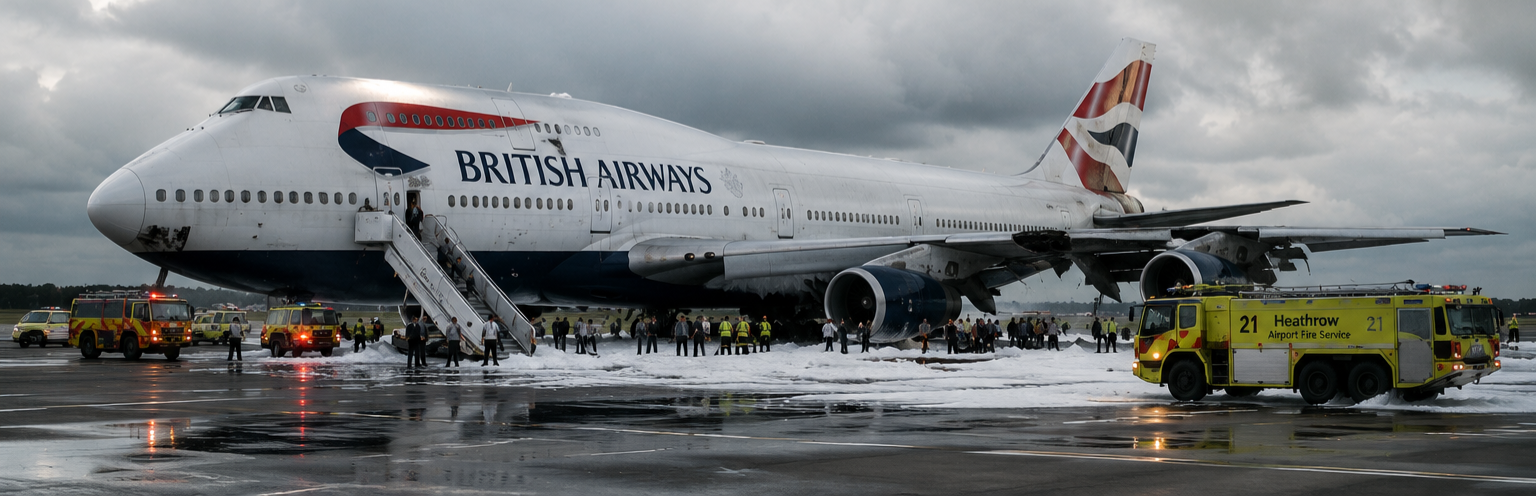
The Physics of Gliding
How long an aircraft can glide is determined by three factors. First is altitude. Second is drag. The less drag, the longer an aircraft can glide. Third is weight.
British Airways Flight 9 had a total weight of approximately 735 tons. Starting from 12,400 meters, its theoretical glide range was about 240 kilometers. Captain Eric Moody carefully managed fuel consumption, maintained a stable attitude, and avoided unnecessary maneuvers.
18 Minutes of Drama Above the Java Sea
When all engines failed above the Java Sea, Captain Eric Moody and his first officer immediately grasped the severity of the situation. They reported the emergency to London Air Traffic Control. "All engines have failed." The response was silence.
The aircraft began to glide. It was losing altitude at roughly 700 meters per minute. The pilots worked to optimize the glide angle. Too steep, and the aircraft would gain speed, increasing drag and causing it to descend rapidly. Too shallow, and there wouldn't be enough lift, risking a stall.
Meanwhile, passengers prayed while crew members prepared for an emergency landing. For thousands of kilometers in every direction over the Indian Ocean, there were no airports. The only hope was a small flying school airfield in Indonesia. The distance was approximately 240 kilometers. Exactly at the limit of the aircraft's gliding range.
The Miracle at 2,000 Meters
At 4,000 meters, the airfield came into view. But there was a problem: the hydraulic system had failed, and the landing gear couldn't be lowered.
Captain Moody executed the emergency procedures he had trained for. He attempted to restart the engines, and at 2,000 meters, Engine Number 4 roared back to life. After 18 minutes of gliding, the aircraft touched down. Tires burst and the braking system malfunctioned. But all passengers and crew members survived.
Later investigation by mechanics revealed that volcanic ash had accumulated inside the engine turbines, simultaneously disabling all four engines. Following this incident, airlines strengthened their training protocols to prepare pilots for all-engine-failure scenarios.
The Beginning of Gliding Training
After this incident, pilots regularly undergo gliding simulations. These drills train them to maintain altitude during an all-engine-failure scenario, calculate glide distance, and determine suitable landing sites. Without this training, the 1982 miracle would have been a tragedy.
British Airways Flight 9 demonstrates how perfectly human knowledge and aircraft design can work together. The pilot's composure, the engineer's design, and the physics of lift—all these elements converged.
Airplanes Fly on Physics
The next time you're on a flight and the engine sound quiets down, remember this: the wings beneath you are still cutting through the air. Lift is still working. And your pilot has all the gliding calculations running through his mind.
Airplanes fly on principles far older than engines themselves. Aerodynamics. The British Airways 747 above the Java Sea in 1982 proved it. Even with all engines shut down, it flew 240 kilometers in 18 minutes. That wasn't a miracle—it was physics.
'✈ 비행과 공부 > 가볍게 읽는 글' 카테고리의 다른 글
| 27편 — 엔진 4개가 모두 멈춘 비행기, 18분간 활공하여 착륙하다: British Airways Flight 9의 기적 (0) | 2026.06.07 |
|---|---|
| GPS 위성과의 교신 — 하늘 위의 신호 (0) | 2026.06.06 |
| GPS Satellites and Communication — Signals from the Sky (1) | 2026.06.06 |
| New Delhi Mid-Air Collision: 349 Deaths, July 6, 1996 (0) | 2026.06.05 |
| 25편 — 1996년 7월 6일 뉴델리 상공 충돌 사고: ATC 레이더 고장이 만든 비극 (0) | 2026.06.05 |


댓글