Have you ever looked down at a city from an airplane window? Even under the darkness of a night sky, even in the middle of the Pacific Ocean, airplanes navigate with remarkable precision toward their destinations. It's a fascinating question: how does this mysterious navigation work? Modern aircraft navigation systems represent some of humanity's most sophisticated guidance technology.
GPS Satellites and Communication — Signals from the Sky
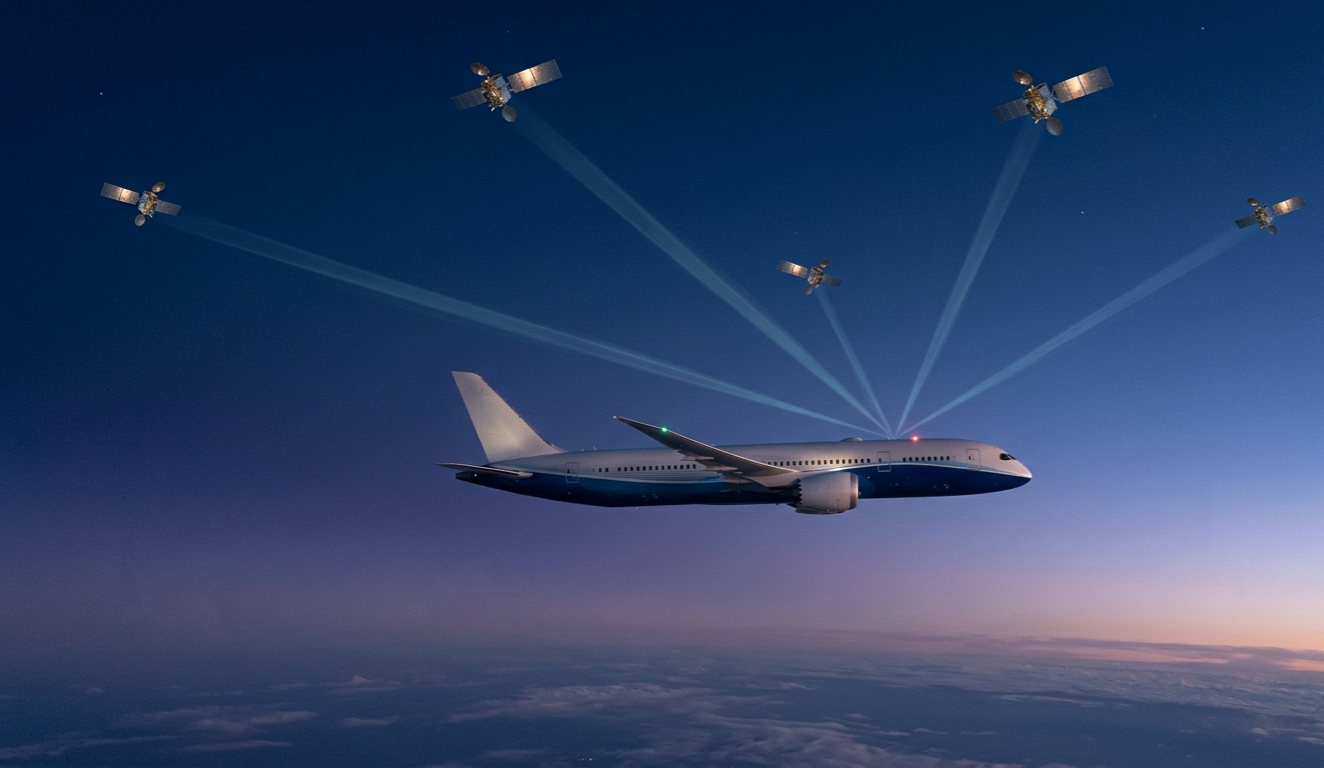
The most fundamental way an airplane determines its position in the sky is through GPS (Global Positioning System). This system, consisting of over 30 satellites orbiting Earth at approximately 20,200 kilometers altitude, was completed in 1995.
An aircraft's receiver communicates with a minimum of four satellites to calculate its exact position. The principle behind GPS signal reception is similar to triangulation — like receiving signals from four lighthouses simultaneously to determine your location.
The GPS signal error range received by aircraft is approximately 15 meters horizontally and 25 meters vertically. While sufficient for the average driver, this represents a considerable margin of error for an aircraft traveling at 900 kilometers per hour. This is why airplanes cannot rely on GPS alone — additional navigation methods are essential.
INS — The Backup Navigation System
The INS (Inertial Navigation System) installed in aircraft operates on an entirely different principle than GPS. Composed of gyroscopes and accelerometer sensors, this device detects the aircraft's movements directly.
Even without GPS signals, the INS can calculate the aircraft's position. After receiving the exact starting point at takeoff, it continuously records all acceleration changes and rotations to estimate the current location. Think of it as the aircraft's "memory."
GPS and INS have different strengths. GPS offers high accuracy but depends on signal reception. INS operates without signals but accumulates error over time. Modern aircraft use both systems simultaneously, compensating for each other's weaknesses. During long-distance flights, their cooperation can reduce error to within just a few meters.
The Actual Navigation Process — From Incheon to Hong Kong
Let's examine how an aircraft actually reaches its destination. Consider a flight from Incheon to Hong Kong, approximately three hours one way.
As the aircraft leaves the gate, the pilot enters the exact departure coordinates (N37.46°, E126.45°) — the precise latitude and longitude of Incheon International Airport — into the FMC (Flight Management Computer).
About three minutes after takeoff, the aircraft reaches approximately 2,000 meters altitude, where GPS signal reception stabilizes. From this moment, the FMC uses GPS data to verify and correct INS errors. On the display, you can watch the positional difference between GPS and INS gradually narrow.
The flight path is predetermined. Departing Incheon, the aircraft follows the standard route labeled INCHEON-5D, heading south and passing through a point approximately 100 kilometers south of Jeju (N32.5°, E125.8°) before heading toward Hong Kong. The aircraft passes through each waypoint on this route precisely, maintaining course deviation within 100 meters through GPS and INS cooperation.
SBAS System and VOR — Toward Even Greater Accuracy
GPS alone remains insufficient. To address this limitation, SBAS (Satellite-Based Augmentation System) was developed. The MTSAT satellite used by Korea and Japan, remaining in a fixed orbital position, analyzes measurements from ground stations and transmits corrected GPS signals. This reduces the error range from 15 meters to within 5 meters.
As the aircraft receives VOR (VHF Omnidirectional Range, frequencies 108-118MHz) signals from ground stations, it undergoes additional correction. With these multiple layers of backup and correction, modern aircraft can reach their destination with error margins of just a few meters.
Ultra-Precise Navigation During Landing — The ILS System
Landing represents the most dangerous moment of an aircraft's journey, especially in poor visibility or at night. This is where the ILS (Instrument Landing System) becomes crucial.
As the aircraft approaches Hong Kong Airport, it switches to precision approach mode. The ILS receives very narrow radio waves from ground equipment installed near the runway, guiding the aircraft to descend precisely along the runway centerline. The error margin is merely ±6 meters.
Even on a foggy night, pilots can land by simply reading the numbers on their display. Without ILS, such flights would be impossible.
Two minutes before landing, the aircraft begins its approach at 300 meters altitude. At this point, GPS accuracy must be precise to the order of tens of centimeters. The pilot follows the automated ILS signals. When the aircraft touches the runway, its altitude is 0 meters and the horizontal position error is within tens of centimeters.
Next-Generation Navigation Systems — PBN and the Future of Aviation
The aviation industry is now moving beyond navigation systems centered on GPS, INS, and ILS. PBN (Performance-Based Navigation) integrates satellite signals with ground station signals, enabling more flexible route planning.
Airlines can design flight paths closer to direct routes, saving fuel and reducing carbon emissions. Dynamic route planning tailored to weather and time conditions is expected to replace fixed airways.
In the more distant future, new navigation systems based on 5G communications and ultra-precise navigation using quantum sensors are anticipated.
Conclusion
The next time you board an airplane, take a close look at the flight path map displayed on the screen after takeoff. That line on the screen is not merely a picture. It's the result of signals continuously exchanged every second among over 30 satellites in the sky, countless radio stations installed on the ground, and the complex sensors within the aircraft.
The navigation system is the cornerstone of modern aviation that safely guides aircraft to their destinations. Right now, somewhere in the sky, this technology enables hundreds of aircraft to navigate with precision. Without these navigation systems, today's aviation network would not exist.
'✈ 비행과 공부 > 가볍게 읽는 글' 카테고리의 다른 글
| BA Flight 9: 747 Glides 18 Minutes to Safety (0) | 2026.06.07 |
|---|---|
| GPS 위성과의 교신 — 하늘 위의 신호 (0) | 2026.06.06 |
| New Delhi Mid-Air Collision: 349 Deaths, July 6, 1996 (0) | 2026.06.05 |
| 25편 — 1996년 7월 6일 뉴델리 상공 충돌 사고: ATC 레이더 고장이 만든 비극 (0) | 2026.06.05 |
| 비행기 조종간의 정보들 — 손 안의 하늘을 조종하는 방법 (4) | 2026.06.04 |


댓글