How Do Airplanes Land and Take Off Safely? The Pilot's Checklist
Every time you board an airplane, just before takeoff or after landing, you can hear the pilots and co-pilot murmuring from the cockpit. What they're reading is a flight checklist made up of dozens, sometimes hundreds of items. The reason airplanes can fly at 900 kilometers per hour carrying 400 passengers, and why aviation accidents are extremely rare in modern times, is because of these checklists.
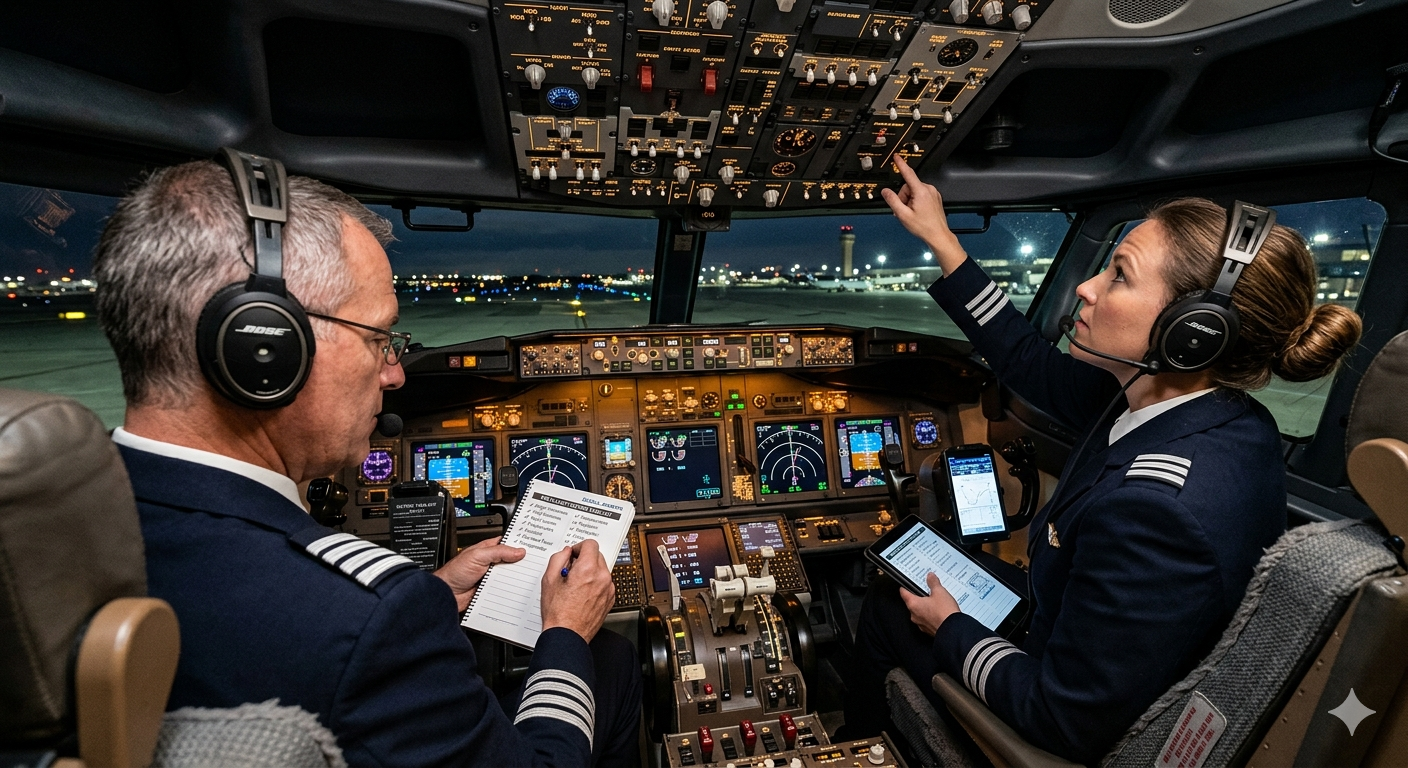
The Checklist: A Life-Saving System
In 1935, the U.S. Army Air Corps developed a new twin-engine bomber. For the time, it was a massive and complex aircraft, and during its first flight tests, even experienced pilots failed to control it and crashed. The airplane was simply too complex to memorize all the necessary procedures. It was then that pilots came up with a systematic checklist. What started as a simple list evolved alongside aviation itself.
Today, the takeoff and landing checklists for modern aircraft like the Boeing 787 or Airbus A380 are so extensive that they span over 50 printed pages. Aviation safety experts credit these checklists with making modern aviation as safe as it is. Robert Sumwalt, an aviation safety expert at NASA, said it best: "Checklists are the most effective tool for correcting human error."
What Happens in the Cockpit Before Landing
Pilots begin preparing for landing 30 minutes before the aircraft approaches the runway. The approach checklist consists of 20 items: confirming the direction of the landing runway, checking the runway's length and condition, verifying wind direction and speed (typically, the headwind should be between 25 and 35 kilometers per hour), and confirming that all landing equipment is operational.
As the co-pilot reads each item aloud, the captain visually confirms each one and responds "Complete." All of this is conducted in English—the international aviation standard. When a pilot says "Gear down, three green lights confirmed," it means all three landing wheels have descended and locked properly.
The Tension of Landing: From 800 Meters to Zero
The landing checklist begins the moment the runway becomes visible. At this point, the aircraft is maintaining an altitude of approximately 800 meters. The pilot must simultaneously observe:
- Distance to the runway
- Landing speed (typically 270 kilometers per hour for a Boeing 737, 280 for an Airbus A350)
- Fuel status
- Aircraft attitude (pitch and roll angles)
- Surrounding weather, especially sudden wind shifts
At 500 meters, the automatic landing system receives a final check. Most modern aircraft land automatically using ILS (Instrument Landing System). Even though the pilot has their hands on the controls, it's actually the machine guiding the aircraft toward the runway centerline. When a pilot says "Stabilized approach confirmed," it means all parameters are within normal ranges.
At 100 meters, the spoilers are deployed—small plates on the wings that increase air resistance to prevent the aircraft from descending too quickly. Every step of the checklist has scientific basis, and missing even one item can compromise safety.
Normal Landing and Go-Around Situations
If a problem occurs during landing, the pilot can decide to execute a "go-around"—aborting the landing and climbing again. This decision must be made before reaching Decision Altitude (DA), typically around 200 meters. If the runway is not clearly visible before DA, the pilot must abandon the landing and climb.
When a go-around occurs, the pilot declares "Aborting landing, climbing to 2,000 feet" and begins a new checklist. The co-pilot reads the climb checklist while the pilot reconfirms each item. As the aircraft circles upward, the pilots determine what went wrong. Most go-arounds result from runway deterioration, sudden wind shifts, or obstacles in the landing path.
Emergency Checklists
What if an engine fails during flight? What if the flight control system malfunctions? Airlines have emergency checklists prepared for every conceivable crisis. These are much simpler than regular checklists—the engine fire checklist, for instance, has just 6 items. But executing those 6 items correctly can mean the difference between life and death.
In 2009, when US Airways Flight 1549 ditched in New York's Hudson River, Captain Chesley Sullenberger and First Officer Jeffrey Skiles saved all 155 people on board through a combination of split-second judgment and trained checklists. When both engines failed simultaneously, they rapidly executed the emergency procedures and chose to glide to the runway without power.
The Balance Between Automation and Manual Verification
Modern aircraft perform most takeoffs and landings automatically. The Airbus A380 is even designed to perform both completely automatically. Yet airlines and regulatory agencies still require pilots to perform manual verification at every stage. Why? Because machines excel in expected situations, but humans can respond to unexpected ones.
In 2013, when Asiana Flight 214 was landing in San Francisco, the automatic landing system failed to engage, forcing pilots to take manual control. The landing speed was too low. It was the pilots' manual intervention and situational awareness that prevented disaster. The National Transportation Safety Board (NTSB) concluded that without the pilots' checklist execution and situational awareness, the fatality toll would have been far higher.
Trust in the Sky
The next time you board an airplane, listen carefully to the pilots' murmuring voices during the landing process. It's not merely procedure. It's a scientific system built to protect your life. Every item on the checklist, every number, has been created from decades of aviation experience and analysis of hundreds of accidents.
While technology contributes to aircraft safety, what matters even more is the existence of these systematic verification processes. According to U.S. FAA statistics, the fatality rate for U.S. domestic flights in the 2010s was approximately one fatal accident per 11 million flights. Commuting by car every day is 40 times more dangerous than flying.
This remarkable safety record ultimately stems from a world where every pilot can confidently say "Preflight checklist complete" each time they take off or land—a world where human precision, systematic thinking, and unwavering procedure protect hundreds of thousands of lives every single day.
'✈ 비행과 공부 > 가볍게 읽는 글' 카테고리의 다른 글
| Understanding the Airplane Autopilot — How Modern Aircraft Fly on Their Own (1) | 2026.06.03 |
|---|---|
| 비행기 자동 조종 장치 — 조종사 없이 비행기가 나는 이유 (0) | 2026.06.03 |
| 비행기는 어떻게 안전하게 이착륙할까? 조종사의 체크리스트 (0) | 2026.06.02 |
| How Aircraft Fire Detection Systems Save Lives (0) | 2026.06.01 |
| 비행기 화재 감지 시스템 — 언제 꺼내야 할지 판단하는 첫 번째 방어선 (0) | 2026.06.01 |


댓글