There's an orange box in every aircraft cockpit. The black box. On August 12, 1985, Japan Airlines Flight 123, traveling from Osaka to Tokyo, crashed in a mountainous region near Tokyo. Five hundred twenty people were on board. Only four survived. But the black box faithfully recorded what those four experienced. It became the evidence that explained exactly why that plane fell from the sky.
Why Did the Plane Crash?
Japan Airlines Flight 123 departed Osaka International Airport (Itami) at 4:12 p.m. About twelve minutes later, an urgent warning alarm sounded in the cockpit. The aircraft became increasingly difficult to control. For thirty-two agonizing minutes, the pilots fought to maintain control before the aircraft collided with a mountain in Gunma Prefecture, near Tokyo.
Search teams found the orange box among the wreckage. The exterior was severely damaged by heat and impact, but the electromagnetic shielding inside protected the data. Investigators from Japan's Aircraft Accident Investigation Commission (JATSB) analyzed the information contained in that box and determined the cause of the crash.
Two Recording Devices Inside the Black Box
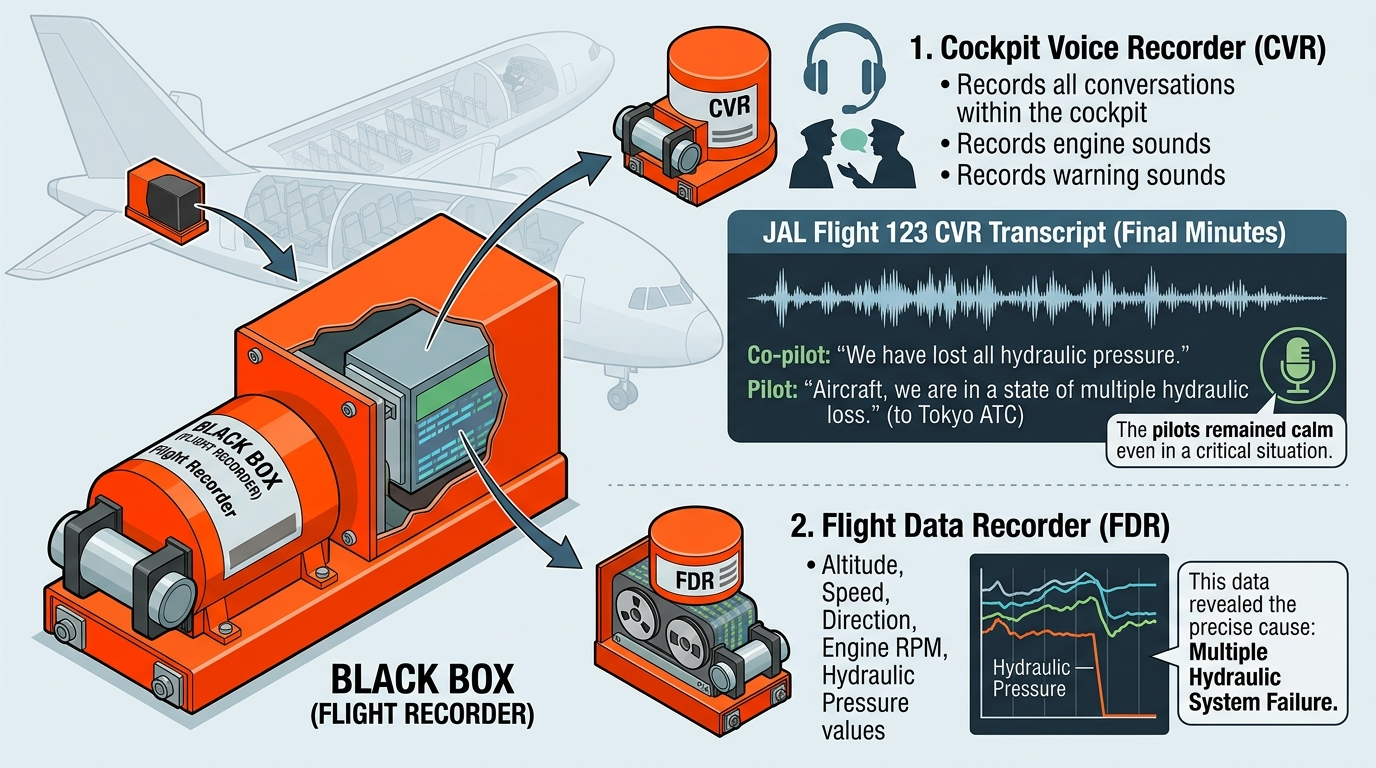
The black box actually contains two separate recording systems.
The first is the Cockpit Voice Recorder (CVR). It captures every conversation in the cockpit, engine sounds, and warning alerts. In the voice recording from Japan Airlines Flight 123, there was a critical exchange between pilots in their final moments. The first officer's words were especially telling: "All hydraulic pressure lost." Even facing the complete failure of all hydraulic systems, the pilots remained composed. They reported to Tokyo Air Traffic Control: "Airfreight, we have experienced a multiple hydraulic systems failure."
The second is the Flight Data Recorder (FDR). It logs over a thousand parameters—altitude, speed, direction, engine RPM, hydraulic pressure, and more—multiple times per second. This data revealed the precise cause.
The Pressurized Bulkhead Rupture
Through analysis of the FDR data and physical examination of the wreckage, investigators reached a definitive conclusion: the pressure bulkhead at the rear of the aircraft had ruptured. This bulkhead maintains cabin pressure. During cruise at approximately 7,400 meters altitude, it maintains cabin pressure at roughly 0.75 atmospheres.
The FDR data showed a sudden pressure loss at 7,300 meters. As the bulkhead fractured, the air inside the cabin rapidly attempted to equalize with atmospheric pressure. The force of this decompression destroyed other structural components and, most critically, damaged all the hydraulic lines.
Why had that bulkhead failed? Investigation revealed that years earlier, the aircraft had suffered rear damage in a landing accident. The pressure bulkhead had been damaged then, and repairs had not followed proper procedures. The incorrectly repaired bulkhead couldn't withstand the stresses of flight and eventually gave way.
The Pilots' Final Struggle
The voice recording captures the pilots' desperate efforts. Even with complete hydraulic failure, the pilots and first officer attempted to regain control. They searched for auxiliary flight control systems and tried to steer using engine thrust alone.
The voice recording ends around 5:33 p.m. At 1,500 meters altitude, the pilot spoke his final words. Then the aircraft hit the mountain.
Survival and the Limits of Investigation
Four people survived out of 520. Their survival demonstrated that impact at a lower altitude and certain seating configurations offered some protection. But the black box couldn't save them. The black box's purpose is to reveal the truth after a disaster, not to prevent it.
As a result of the investigation, Japan Airlines strengthened its maintenance standards. Airlines worldwide adopted lessons from this accident, designing more robust hydraulic systems with redundancy and backup systems. The evidence preserved in the black box drove these changes.
What the Black Box Tells Us
When flight attendants conduct safety demonstrations, it's because of accidents like this one. And at the heart of how those accidents become solutions is always the black box's record.
Without the black box, investigators would never have known the pressure bulkhead had ruptured. Without identifying the technical failure, prevention is impossible. The black box is the witness that reveals the truth of aircraft accidents. It's painted orange so it can be easily found in wreckage.
The records inside that box have been transformed over the past four decades into regulations and technologies that have protected hundreds of thousands of passengers. Safety in the air is the legacy of the black box recordings left behind by past tragedies.
'✈ 비행과 공부 > 가볍게 읽는 글' 카테고리의 다른 글
| Episode 16 — The Structure and Role of Airplane Wings (0) | 2026.05.28 |
|---|---|
| 16편 — 비행기 날개 구조와 역할 (0) | 2026.05.28 |
| 15편 — 일본항공 JAL 123편 추락 사건(1985년 8월 12일) — 블랙박스가 밝힌 기압 격벽 파열의 진실 (1) | 2026.05.27 |
| Emirates Flight 521 — The Evacuation Slide That Saved 300 Lives (0) | 2026.05.26 |
| 에미레이츠 521편 — 탈출슬라이드가 구한 300명의 생명 (0) | 2026.05.26 |


댓글