Episode 12 — Why Airplane Windows Are Round
Airplane windows are invariably round in shape. Even when the window frame is rectangular, the glass itself is oval or circular. This isn't simply a design choice. It's the result of a tragedy from decades ago and the laws of physics combined.
The de Havilland Comet Disaster
In 1954, the British de Havilland Comet was making headlines as the world's first commercial jet airliner. Yet within just one year, two aircraft of the same model crashed mid-flight. On January 10, 1954, a passenger plane heading to Rome vanished over the Mediterranean. On April 8, another similar catastrophe occurred over Osaka, Japan. Both disasters claimed 119 lives each.
The investigation team salvaged the wreckage of the first Comet and analyzed it. The fuselage hadn't been destroyed by an explosion. Instead, it had been systematically torn apart from a specific point. The culprit was the window design. The Comet's windows were square.
The Principle of Stress Concentration
At an altitude of 10,000 meters, the pressure difference between inside and outside the aircraft reaches approximately 60 kPa. In a Boeing 747, the total outward force acting on the fuselage reaches about 1,100 tons. If this enormous force is distributed evenly, there's no problem. But if it concentrates at specific points, the material breaks.
This is stress concentration. Angular shapes, particularly right angles, are weak points where stress easily accumulates. The corners of the Comet's square windows experienced loads far greater than the average stress. With thousands of takeoffs and landings, the metal at those points gradually weakened. Fatigue cracks developed. One day, during flight, those cracks suddenly expanded, and the fuselage separated.
The Mathematical Superiority of Circles
A circle is a geometrically perfect shape. Every point on the circumference is equidistant from the center. Stress is distributed evenly across the entire circumference. With no right angles, there are no stress concentration points.
When equal outward pressure is applied to a square and a circle of the same size, the stress in the circle is much lower than in the square. After the Comet disaster, all airlines switched to round or oval windows. This is why nearly all modern aircraft have rounded windows.
The Internal Structure of Airplane Windows
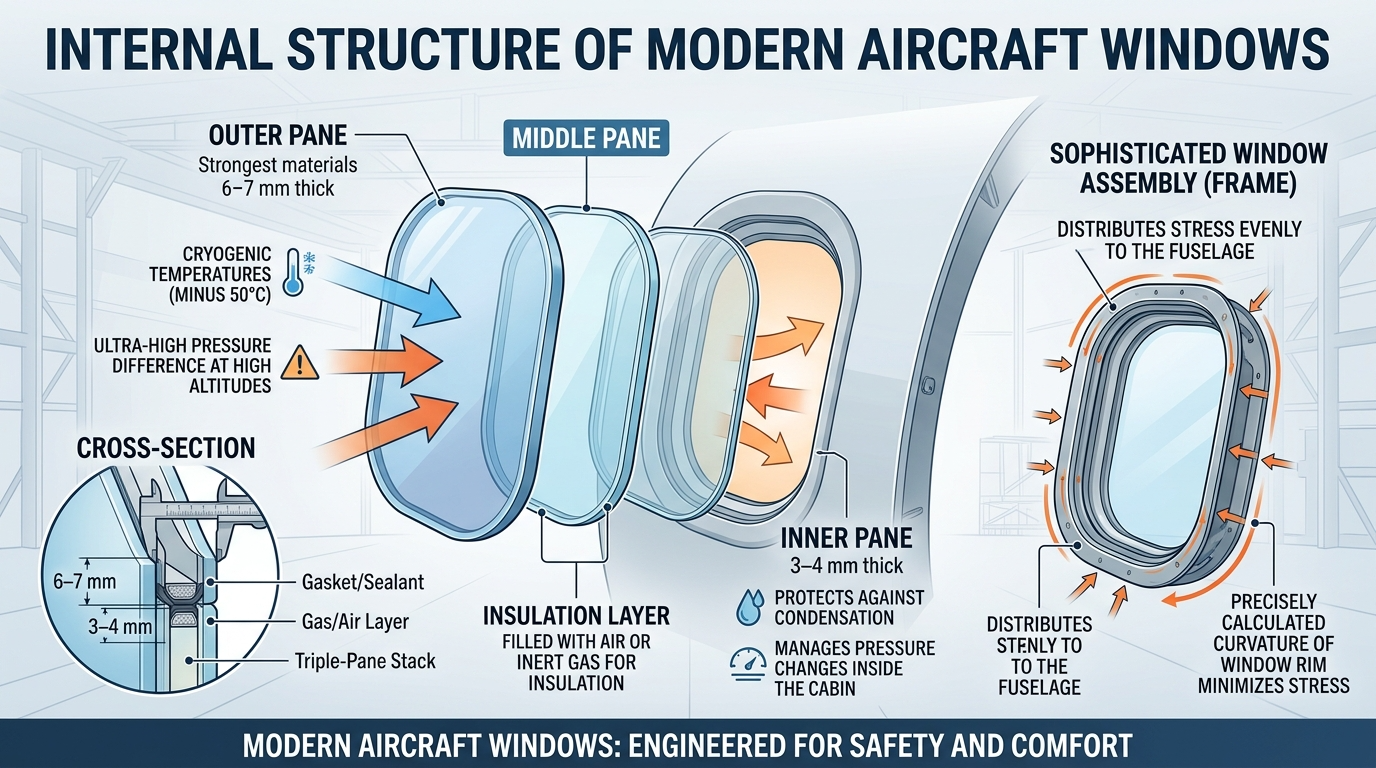
Modern airplane windows consist of three layers. From outside inward, they are the outer pane, middle pane, and inner pane.
The outer pane is directly exposed to extreme cold at altitude (below minus 50 degrees Celsius) and extreme pressure differences. It's made from the strongest materials and is 6-7 mm thick. The middle layer is filled with air or inert gas to provide insulation. The inner pane protects against condensation and pressure changes inside the cabin, and is 3-4 mm thick.
Each window is surrounded by a sophisticated frame called the window assembly. It's engineered to distribute stress evenly across the fuselage. The curvature of the window's edges is also precisely calculated to minimize stress.
High-Altitude Flight and Pressure Management
When an aircraft flies steadily at 10,000 meters, the pressure difference between inside and outside the fuselage reaches about 60 kPa. On a Boeing 737 with 100 passengers aboard, the outward force acting on a single window is substantial.
To withstand this pressure, airplane windows are subject to strict standards. Airlines regularly inspect windows to ensure no hairline cracks have developed. If cracks are found, the entire window is replaced. The cabin pressure is automatically managed by computer. During ascent and descent, the rate of pressure change is controlled to gradually apply load to the windows.
Aviation Regulations and Safety Standards
The International Civil Aviation Organization (ICAO) and the U.S. Federal Aviation Administration (FAA) have established strict regulations for airplane windows. All commercial aircraft windows must meet the following criteria.
First, even if one window is completely destroyed, the aircraft must be able to fly safely. Second, windows must withstand at least 1.5 times the maximum cabin pressure. Third, window materials must pass fatigue crack tests. Cracks must not develop even after tens of thousands of pressurization-depressurization cycles.
All aircraft follow regular window inspection protocols. Visual inspections are conducted every 100 flight hours, and precision ultrasonic inspections are performed every 1,000 flight hours. If even a single crack is detected, that window is immediately replaced.
In Conclusion
The round shape of airplane windows embodies 70 years of aviation engineering evolution. What the 1954 Comet tragedy demonstrated was the importance of simple geometry. Angular corners concentrate stress; circles distribute it. Every modern airplane window follows this principle. Airlines and engineers inspect these windows after every flight. Delivering passengers safely to their destination—that is the role of the airplane window.
'✈ 비행과 공부 > 가볍게 읽는 글' 카테고리의 다른 글
| Why Airplane Seats Are Orange: The Science Behind Your Seat (0) | 2026.05.25 |
|---|---|
| 역사의 전환점 - 생명을 살리는 비행기 좌석 구조 (0) | 2026.05.25 |
| 12편 — 비행기 창문이 동그란 이유 (0) | 2026.05.24 |
| Boeing 787's Lighting System Battles Jet Lag (0) | 2026.05.23 |
| 보잉 787의 전자식 객실 조명: 창 밖의 밤을 조종하다 (0) | 2026.05.23 |


댓글