Boeing 787's Electronic Cabin Lighting: Taking Control of the Night Outside Your Window
You've probably experienced it: sitting on a plane while the world outside remains dark, yet the cabin suddenly brightens. It seems like a simple convenience, but it's actually the result of sophisticated science designed to trick your body. For frequent flyers, jet lag and sleep disruption during long international flights are among the biggest concerns. Modern aircraft are now addressing this problem directly—using light itself as a tool.
The Biology of Jet Lag
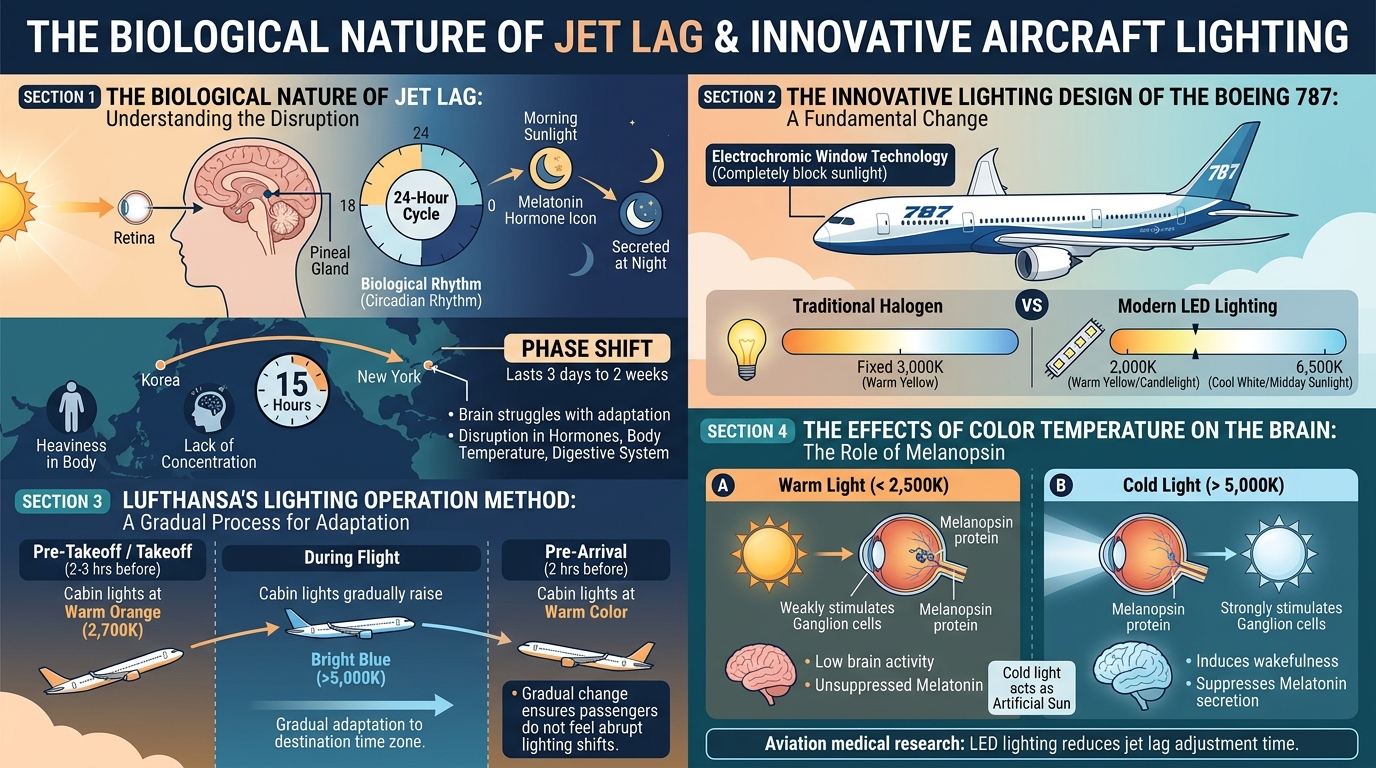
The human body operates on roughly a 24-hour biological rhythm called the circadian rhythm. Light entering through the retina signals the brain's pineal gland, telling it whether it's day or night. Melatonin, the sleep hormone, is released when it gets dark and suppressed by morning sunlight. Cross a 15-hour time zone, and this entire system becomes completely disrupted.
On a flight from Seoul to New York, the heaviness, brain fog, and insomnia passengers experience aren't ordinary fatigue—they're the result of a sudden phase shift in the body's internal clock. In aviation medicine, this is understood as a disruption to circadian rhythms rather than simple tiredness. The condition typically lasts anywhere from three days to two weeks. During that time, your brain struggles to adapt to the new time zone while hormones, body temperature, and digestive function all recalibrate.
Boeing 787's Revolutionary Lighting Design
Everything changed when the Boeing 787 Dreamliner entered service. For the first time, an aircraft featured electrochromic window technology—allowing complete blockage of sunlight streaming through the windows. But the more transformative innovation was converting all cabin lighting from halogen to LED.
Traditional halogen bulbs emit light at a fixed color temperature of around 3,000K. LED lighting can be adjusted freely between 2,000K and 6,500K—from warm amber to cool white, creating everything from candlelight to midday sun artificially. Lufthansa was the first airline to implement this technology operationally, and their approach is instructive. Beginning two to three hours before landing, they lower cabin lighting to a warm orange (2,700K). During flight, they gradually brighten it to a cool blue-white (5,000K and above). Two hours before arrival, they shift back to warmer tones. The transition is gradual enough that passengers don't consciously notice the shift, yet their circadian rhythm slowly adapts to the destination's time zone.
How Color Temperature Affects the Brain
Why does this subtle shift matter? Retinal ganglion cells contain a protein called melanopsin. Warm light below 2,500K stimulates this protein weakly, while cool light above 5,000K stimulates it strongly. Cool light suppresses melatonin production and keeps the brain alert—essentially functioning as an artificial sun.
Aviation medicine research shows that LED systems reduce circadian adaptation time compared to older halogen aircraft.
Korean Air's Customized Lighting Strategy
Each airline operating the 787 has developed its own lighting schedule. Korean Air's approach works as follows: the first two hours of flight maintain warm lighting (2,500K) to create comfort during the meal service. Over the next 8 to 10 hours, bright white lighting (5,500K) is maintained to heighten alertness. Two hours before arrival, the color shifts back to warm tones (2,500K) to promote sleep after landing.
These color changes are never abrupt. They typically occur gradually over 30 minutes to an hour. This gradual shift significantly improves circadian adaptation efficiency. Sudden changes create discomfort; slow ones are accepted unconsciously.
Importantly, all cabin lighting doesn't change simultaneously. Aisle lights, overhead lights, and seat-level lighting shift in staggered intervals, making the transition feel more natural. Personal reading lights are also color-adjustable, allowing passengers to fine-tune based on their own circadian needs.
Room for Improvement
Boeing 787's lighting innovation is groundbreaking, but it's not a perfect solution. Individual differences matter significantly. Some passengers are highly sensitive to light and notice even minor color temperature shifts, while others barely perceive them.
Sensitivity to light also decreases with age. For passengers over 65, the same lighting produces far weaker effects than for younger travelers. The retina's color-sensing ability diminishes over time.
For those with serious sleep disorders or significant jet lag history, lighting alone isn't enough. These passengers benefit from melatonin supplements, sleep medication, or carefully timed sunlight exposure.
Future aircraft may collect individual biometric data to continuously customize seat-level lighting for each passenger in real time. Airbus is already experimenting with AI-based lighting systems on the A350.
Beyond Simple Brightness Adjustment
On your next flight, observe how the cabin lighting shifts. Notice those subtle color changes—they're working far more deeply on your brain and hormonal systems than you might realize.
That warm glow you see is the result of aviation engineers' scientific effort to overcome fatigue and insomnia for international travelers. Lighting is a tool to help you arrive at your destination in better physical condition. Airlines continue to refine this invisible mechanism, using light itself to reset your biological clock with every flight.
'✈ 비행과 공부 > 가볍게 읽는 글' 카테고리의 다른 글
| Episode 12 — Why Airplane Windows Are Round (0) | 2026.05.24 |
|---|---|
| 12편 — 비행기 창문이 동그란 이유 (0) | 2026.05.24 |
| 보잉 787의 전자식 객실 조명: 창 밖의 밤을 조종하다 (0) | 2026.05.23 |
| Episode 10 — Aircraft Cabin Ventilation: Where Does the Air You Breathe Come From? (1) | 2026.05.22 |
| 10편 — 비행기 환기 시스템: 당신이 숨 쉬는 공기는 어디서 올까 (0) | 2026.05.22 |


댓글