You've probably wondered this at least once while sitting in an airplane: Is the air I'm breathing right now truly clean? At thousands of meters above the ground, sealed inside a metal tube, breathing the same air as dozens of other passengers for hours—how is it even possible? The aircraft cabin ventilation system is not just a convenience. It's a critical safety technology that protects our lives.
Why the Ventilation System Is Essential
The environment inside an airplane cabin is completely different from what we experience on the ground. At 10,000 meters altitude, external air pressure drops to about 26% of sea level pressure. External temperature plummets to minus 55 degrees Celsius, and oxygen concentration becomes dangerously low. The aircraft must maintain cabin pressure at about 80-90% of sea level pressure (equivalent to about 2,400 meters altitude). This requires an enormous amount of compressed air. But where does this air come from? The answer is the engine.
Aircraft engines generate hot, high-pressure air in the compressor stage of the jet engine. Before this air enters the cabin, it undergoes several cooling and filtration processes. Compressed air from the engine exceeds 200 degrees Celsius, so it first passes through an Air Cooler to reduce the temperature to about 40-50 degrees Celsius. Next, moisture is removed. Finally, the air passes through filters that trap fine particles and contaminants. This purified air is then supplied to the cabin.
An aircraft manufacturer representative explained: "The airplane ventilation system is like a water purifier in the sky. It removes any dust or bacteria and delivers only fresh, clean air to passengers."
Air Flow Structure: Top to Bottom
The air in an aircraft cabin must maintain a specific direction of flow. Modern wide-body aircraft (such as Boeing 777 and Airbus A350) have ventilation systems that distribute air through outlets in the ceiling and then draw air back through grilles in the floor. This is called "top-to-bottom" flow. The advantage of this method is that warm air and contaminants from passengers' breathing don't rise upward. Instead, they're diluted by fresh air and expelled.
About 50% of the cabin air is newly introduced from outside, while the remaining 50% is recirculated air—air that's been filtered and reused. This ratio is determined by standards set by the International Air Transport Association (IATA) and the U.S. Federal Aviation Administration (FAA). All recirculated air must pass through a HEPA filter (High-Efficiency Particulate Air Filter), which removes 99.97% of particles larger than 0.3 micrometers. Considering that coronavirus particles measure about 0.1 micrometers, HEPA filters aren't perfect protection, but they provide substantial safeguards.
A Korean airline's flight attendant trainer noted: "How critical cabin ventilation is became clearer after the pandemic. Now we place ventilation system checks at the very top of our safety inspection list."
How Ventilation Changes During Different Flight Phases
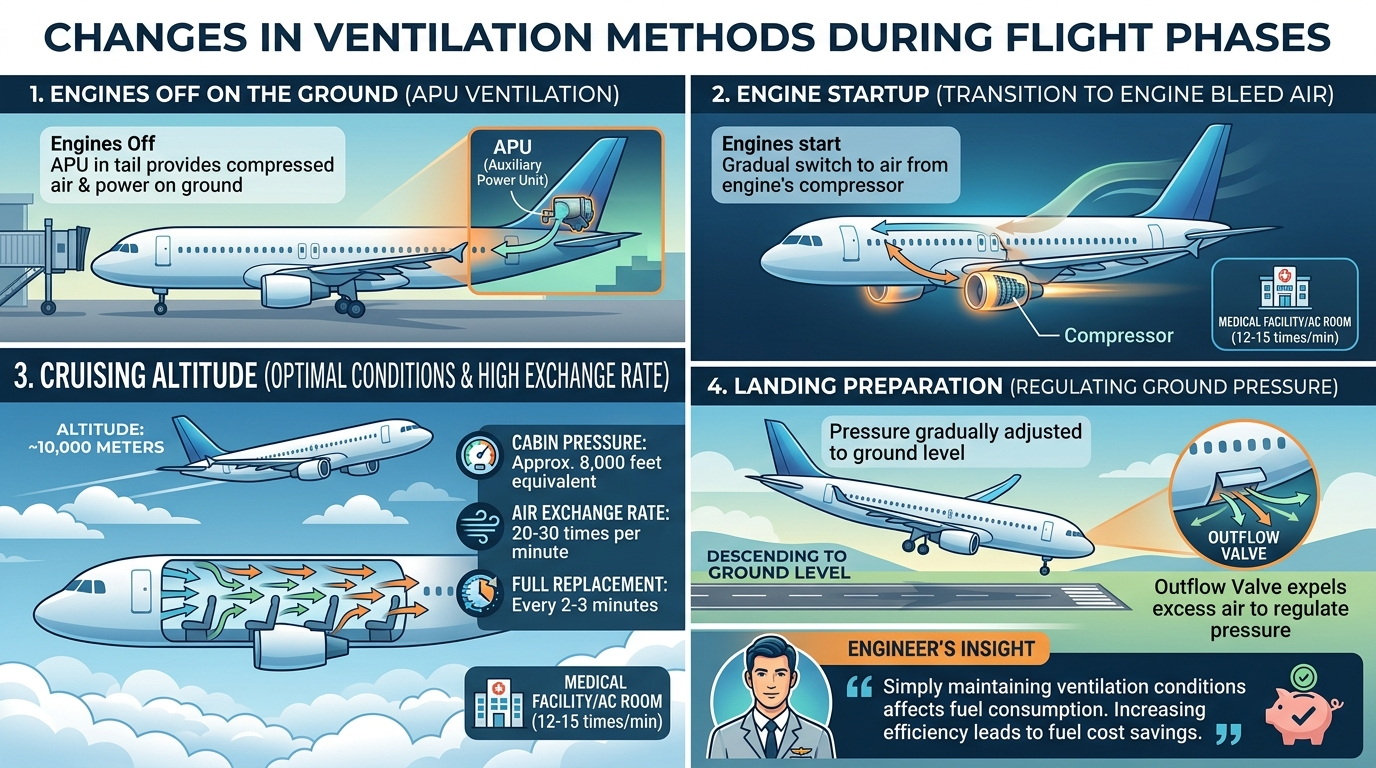
Airplane ventilation methods change depending on the flight phase. When the engine is shut down at the gate, the APU (Auxiliary Power Unit) supplies compressed air to maintain ventilation. The APU is a small turbine engine located at the rear of the aircraft and supplies both power and air on the ground. Once the engines start, the air supply gradually transitions to come from the engine compressors.
After takeoff, once the aircraft reaches cruise altitude (about 10,000 meters), it maintains optimal ventilation conditions. At this altitude, cabin pressure is set to the equivalent of about 8,000 feet (2,400 meters), and the air change rate is 20-30 times per minute. In other words, the entire cabin air is completely refreshed approximately every 2-3 minutes. Considering that medical facilities and clean rooms exchange air only 12-15 times per minute, airplane cabins change air far more frequently than typical indoor spaces.
During descent preparation, the aircraft gradually adjusts cabin pressure to match ground pressure. During this process, as cabin air pressure increases, the ventilation system works to expel the excess air. A device called the Outflow Valve automatically opens and closes to regulate the pressure change.
An aircraft engineering technician explained: "Just maintaining the cabin's ventilation during cruise affects fuel consumption. Even small improvements in ventilation efficiency directly translate to fuel savings for airlines, so we're constantly refining the system."
Negative and Positive Pressure: The Delicate Balance of Pressure Control
One aspect of aircraft ventilation systems that's often overlooked is pressure control. The cabin must always maintain a slight positive pressure state—meaning the cabin's internal pressure must be higher than external pressure. If the cabin becomes negatively pressurized, the external low pressure would squeeze the cabin, damaging its structure and creating an explosion hazard.
Conversely, if cabin positive pressure becomes too high, excessive stress is placed on doors and windows. To prevent this, aircraft have a Pressurization System—an automatic control device. This system continuously monitors cabin pressure through sensors and automatically adjusts the Outflow Valve opening to maintain pressure within a specific range.
Pilots can also manually control cabin pressure if needed. Should the pressurization system's sensors malfunction and manual control becomes necessary, pilots can increase or decrease pressure through the Pressurization Panel in the cockpit. However, this is used only in emergencies; most of the time, the automatic system operates with remarkable precision.
According to FAA regulations, aircraft cabins must maintain enough pressure that pilots can remain conscious without oxygen masks even at 10,000 meters altitude. This is why cabin pressure is maintained at 80-90% of sea level pressure. Too low, and passengers feel altitude sickness symptoms; too high, and the airframe structure suffers damage.
An aircraft maintenance technician emphasized: "Errors in the pressure control system represent one of the most serious aviation safety concerns. For this reason, this system alone has many redundant safety mechanisms built in."
Actual Inspection and Maintenance
Aircraft ventilation systems are inspected very frequently. After each flight, basic visual checks are performed. Pilots confirm the Pressurization System works properly in their pre-flight checklist. During regular maintenance checks (Monthly Check, C-Check, D-Check), HEPA filters are replaced and air ducts are inspected for leaks.
If air ducts become damaged, the pressure difference at 10,000 meters altitude (approximately 0.76 atmospheres) could cause the duct to rupture. For this reason, duct surfaces are protected with special coatings, and their internal condition is checked regularly using ultrasonic or thermal imaging cameras. If a crack is found in a duct, that section must be patched or the entire duct replaced.
The computer control systems of ventilation are equally critical. Aircraft pressurization systems operate with multiple computers that monitor each other's function. If one sensor or valve fails, another immediately takes over its role. This is called "Redundancy" and is a core principle of aviation safety.
An aircraft maintenance instructor stated: "Inspections of ventilation and pressurization systems are as thorough as engine inspections. Without these systems working properly, the aircraft simply cannot fly as planned."
Future Ventilation Technology
Modern aircraft come equipped with increasingly efficient ventilation systems. Aircraft like the Airbus A380 and Boeing 787 feature higher-performance HEPA filters, more sophisticated automatic pressure control systems, and computer systems that simulate air flow in real-time. Since the COVID-19 pandemic, more airlines have begun adopting UV-C disinfection technology that uses ultraviolet light to sterilize air.
Additionally, some aircraft are introducing the concept of "smart ventilation." This technology dynamically adjusts ventilation levels based on passenger count, flight duration, and outside air quality. It allows airlines to improve fuel efficiency while maintaining optimal cabin air quality.
Closing Thoughts
Next time you fly, take a moment to look at the ventilation outlet in the ceiling. Think about how precisely that quiet hole delivers the air you breathe. That hot, compressed air from the engine compressor must be cooled, purified, filtered, and regulated before it reaches your lungs. This long and complex process is the life-support system that aircraft engineers designed for safety. Your comfort during flight exists because this invisible system operates every single moment.
A safety officer at an airline emphasized: "Passengers know less about the ventilation system than about any other aircraft system. But no matter what system allows an airplane to fly, it's the ventilation system that ensures passengers can keep breathing while that happens."
If you have questions, please leave them in the comments.
Series Information
This article is Episode 10 of the aviation knowledge series.
Complete Series Table of Contents (Episodes 1-20)
- Behind the Scenes at the Airport (Ground Operations)
- The Secrets of Airport Runways (FAA Standards)
- Aircraft Altitude: The Pressurization Mechanism
- Understanding Aircraft Landing Gear Systems
- Aircraft In-Flight Meal Service Systems
- Airport Fueling Systems
- Airport Baggage Handling
- Airport Maintenance Inspections
- Aircraft Cabin Crew Call Systems
- Aircraft Ventilation Systems ← You are here
- Aircraft Cabin Lighting
- Why Airplane Windows Are Round
- The Secret Behind Airplane Seat Colors
- How Aircraft Escape Slides Work
- How to Interpret Aircraft Black Boxes
- Aircraft Wing Structure and Function
- How Aircraft Oxygen Masks Work
- Aircraft Emergency Exit Regulations
- Aircraft Seatbelt Systems
- Aircraft Fire Detection Systems
'✈ 비행과 공부 > 가볍게 읽는 글' 카테고리의 다른 글
| Boeing 787's Lighting System Battles Jet Lag (0) | 2026.05.23 |
|---|---|
| 보잉 787의 전자식 객실 조명: 창 밖의 밤을 조종하다 (0) | 2026.05.23 |
| 10편 — 비행기 환기 시스템: 당신이 숨 쉬는 공기는 어디서 올까 (0) | 2026.05.22 |
| Episode 9 — The Airbus A380's Cabin Crew Call System (0) | 2026.05.21 |
| 9편 — 에어버스 A380의 승무원 호출 시스템 (0) | 2026.05.21 |


댓글