Episode 9 — The Airbus A380's Cabin Crew Call System
On any flight, you'll find a small button on your armrest. Press it when you need a drink or a blanket, and a flight attendant appears. The Airbus A380, the world's largest passenger aircraft, carries over 520 people. On such a massive plane, how does the system handle hundreds of calls efficiently? That's the challenge the A380's call system had to solve.
The A380: Scale and Complexity
The Airbus A380 has been in service since 2007. It measures 73 meters long, 24.1 meters high, and has a wingspan of 79.8 meters. Its maximum passenger capacity ranges from 525 to 840, though airlines typically configure it to carry 400 to 500 passengers.
Narrow-body aircraft like the Boeing 737 or Airbus A320 carry 150 to 200 passengers and need only 5 to 7 cabin crew members. The A380, by contrast, requires 20 to 25 flight attendants, distributed across multiple zones. With the cabin divided into upper and lower decks, managing hundreds of simultaneous calls becomes a challenge that a simple call bell cannot address.
How the Call System Works
The aircraft's call system consists of three main components.
First, there's the call button on the armrest. It operates as a mechanical switch, sending different signals depending on how it's pressed and for how long.
Second, there are call panels installed throughout the cabin at various locations. These display specific seat numbers using bright lighting.
Third, there are wireless communication devices for the crew.
The latest systems used on the A380 are entirely digital. Each button press sends a signal through the aircraft's electronic network to multiple locations simultaneously. It's not just a generic "someone needs help" signal—it identifies which passenger is calling and what type of service they're requesting.
Upper Deck and Lower Deck
The A380's cabin is divided into an upper deck (approximately 140 to 150 seats) and a lower deck (approximately 350 to 400 seats). Each deck operates independently with its own team of flight attendants.
Call signals appear on LCD displays installed in the galleys and crew rest areas on each deck. The A380 has four main call units: forward upper, aft upper, forward lower, and aft lower. If all 520 possible calls appeared on a single screen, attendants would have no way to prioritize. Spatial distribution solves this problem elegantly.
What Happens When You Press
When a passenger presses the call button, several things occur almost instantly.
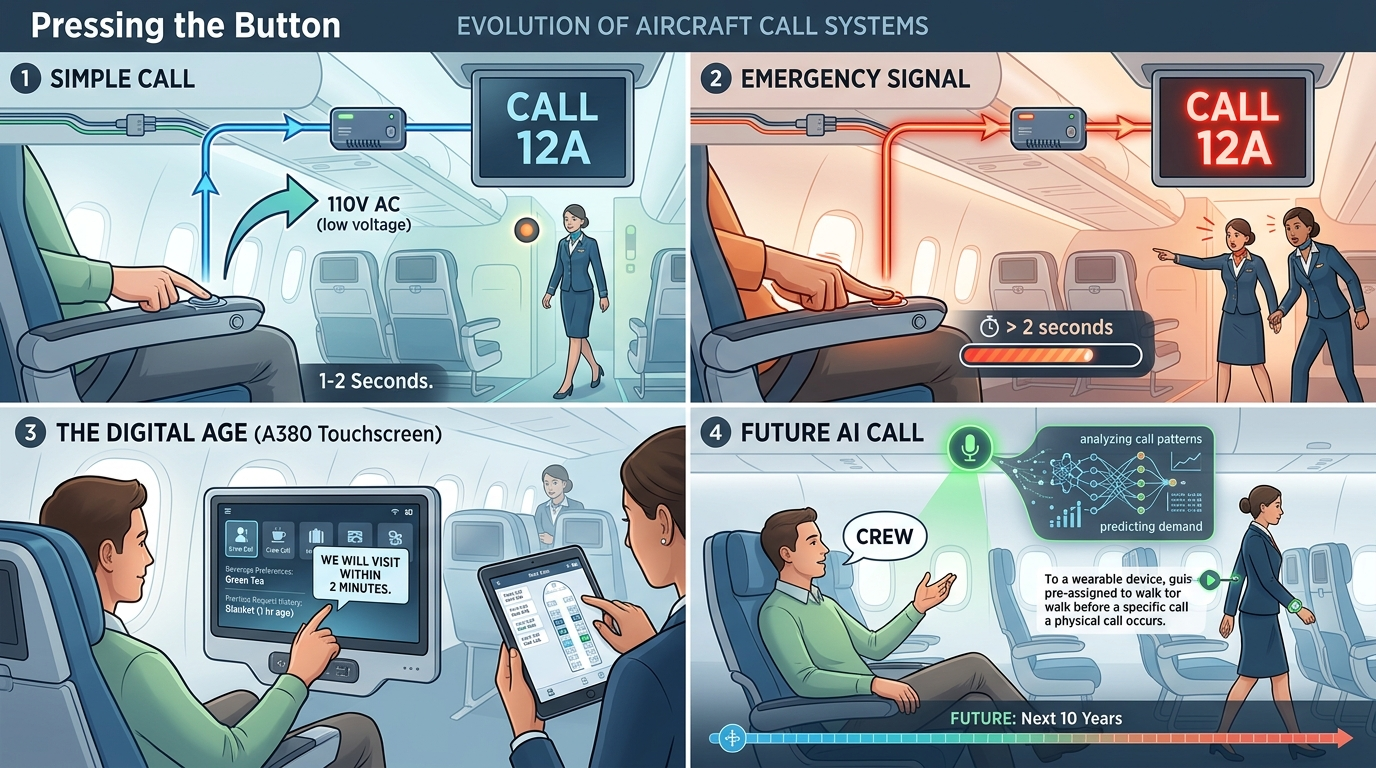
A single button press displays the seat number on the LCD—something like "12A calling." The signal reaches multiple locations almost immediately, and nearby crew members respond.
The electronic signal operates on 110V AC at low voltage. The button signal travels through the aircraft's wiring to the call unit, where circuit boards interpret the signal and display it on screens. The entire process takes just 1 to 2 seconds.
What's particularly clever is how the system interprets different button presses. Hold the button for more than two seconds, and it registers as an "emergency signal." The display shows the seat number in larger text or a different color, allowing crew to immediately recognize an urgent situation. This means the call system isn't a simple on-off switch—it recognizes both signal strength and duration.
The Digital Era
Newer A380s have adopted touchscreen-based call management systems. They don't just display seat numbers; they can also show previous requests and passenger preferences like preferred beverage choices. When a crew member acknowledges a call, an automated message appears on the passenger's seat monitor: "We'll visit you within the next two minutes."
This isn't merely a technological upgrade. On an aircraft carrying 520 people, it reduces the chaos of competing requests, distributes crew workload more evenly, and significantly improves passenger satisfaction. The accuracy of the call system directly affects the quality of the crew's work.
The Future of Call Systems
Recently, systems incorporating voice recognition have been undergoing testing. When a passenger says "flight attendant," the microphone detects it and automatically converts it into a call.
Artificial intelligence-based systems are also in development. These analyze call patterns and predict where crew members should be positioned in advance to respond more quickly. Within the next decade, the A380's call system will likely evolve beyond simple calling to become a predictive system that anticipates passenger needs and responds proactively.
The Technology Behind a Simple Button
Next time you board a flight and press that small call button, consider what happens. The entire aircraft's electronic system pinpoints your exact location and dispatches the nearest of dozens of crew members to help you. On an aircraft like the A380 carrying over 520 passengers, the computation behind that response is far more complex than it appears.
The call button is not just a bell. It's a miniature version of modern aviation technology. Behind every swift response from the crew lies a carefully engineered electronic system and the training of those who operate it.
'✈ 비행과 공부 > 가볍게 읽는 글' 카테고리의 다른 글
| Episode 10 — Aircraft Cabin Ventilation: Where Does the Air You Breathe Come From? (1) | 2026.05.22 |
|---|---|
| 10편 — 비행기 환기 시스템: 당신이 숨 쉬는 공기는 어디서 올까 (0) | 2026.05.22 |
| 9편 — 에어버스 A380의 승무원 호출 시스템 (0) | 2026.05.21 |
| Episode 8 — How Is an Aircraft Prepared After Flight: 72 Hours at the Airport Maintenance Center (0) | 2026.05.20 |
| 8편 — 비행기는 비행 후 어떻게 준비될까: 공항 정비 센터의 72시간 (0) | 2026.05.20 |


댓글