Episode 19 — The Airplane Seatbelt System: Three Straps That Protect You
Every time you board a flight, you watch the flight attendant's seatbelt demonstration. It looks similar to buckling up in a car, but why does it seem so complicated? The truth is, the airplane seatbelt is far more than it appears—it's a life-saving device engineered from decades of accident data and the laws of physics.
Why It's Different From a Car Seatbelt
In a car, the seatbelt runs across your shoulder and pelvis, anchored at a single point. In an airplane, it's different. Two straps wrap around each side of your pelvis, and one strap connects across your chest—a system where three points meet. This is called a "three-point lap seatbelt system."
The fundamental difference lies in how aircraft and cars move. A car accelerates sharply in only forward and backward directions. An aircraft can move simultaneously along three axes: side to side (roll), up and down (pitch), and rotation (yaw). Because of this, the seatbelt must stabilize a passenger's body in three-dimensional space. That's why it must press on both sides of the pelvis while supporting the chest.
Why It Must Be Worn Low Across the Pelvis
Flight attendants always emphasize one thing during the seatbelt demonstration: "Wear it low across your pelvis." This isn't just an instruction—it's a matter of physics.
The human pelvis is extremely strong. This is exactly why the seatbelt is worn there. If the seatbelt were tightened high across the abdomen or chest, sudden deceleration could damage your internal organs. But if it's too loose, you could slip out or be thrown from your seat.
According to aviation safety research, during severe turbulence or technical emergencies involving sudden updrafts, passengers can experience forces of 4 to 6 Gs—four to six times the force of Earth's gravity. Without a properly positioned seatbelt, the human body cannot withstand these forces.
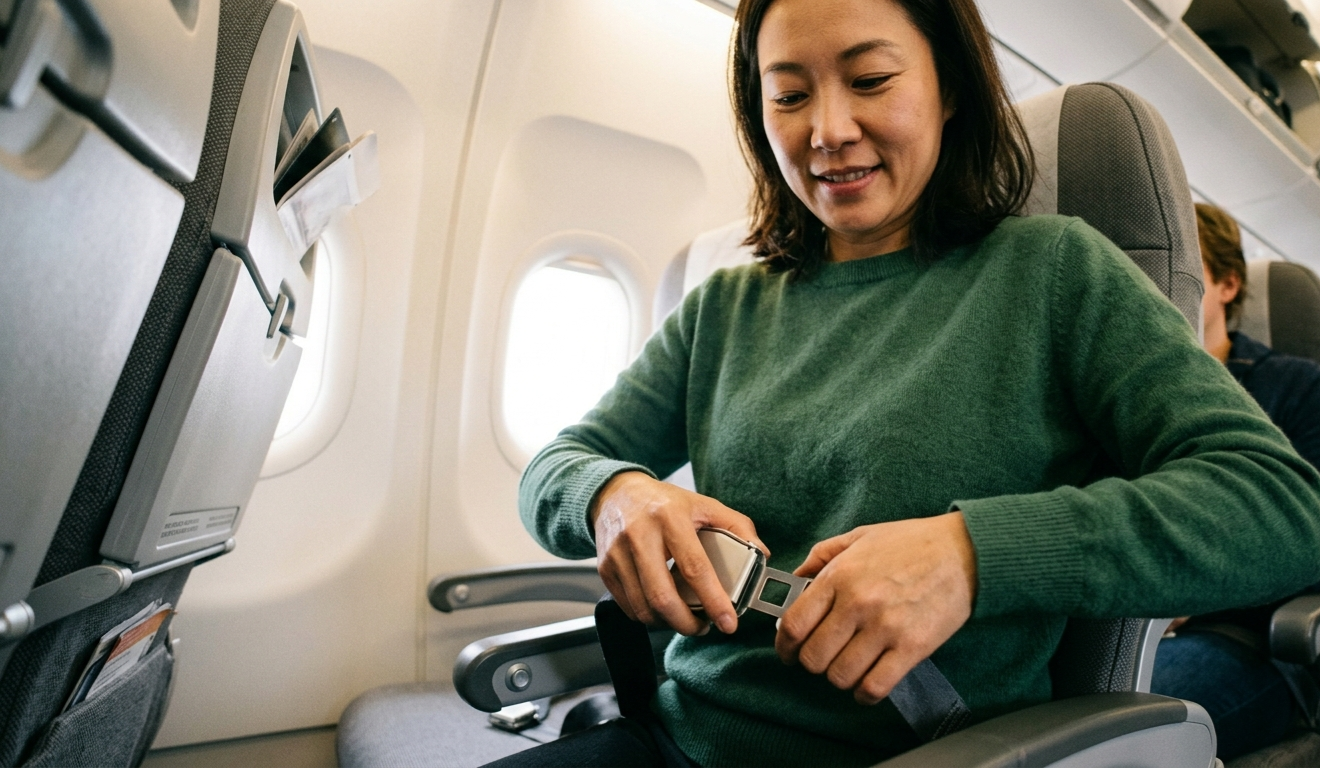
The Dual-Locking Mechanism in the Buckle
If you look closely at an airplane seatbelt buckle, you'll notice it's different from a car's. Two independent metal tabs overlap, and both must be pushed upward simultaneously to release it. This is called a "dual-release buckle."
If your body moves during severe turbulence and the buckle accidentally comes undone, the consequences could be serious. According to standards set by the International Civil Aviation Organization (ICAO), an airplane seatbelt buckle must have a failure rate of no more than once in every 10,000 activations. Thanks to the dual-locking structure, accidental release during turbulence is extremely rare.
Why the Width and Material of the Straps Matter
Airplane seatbelts are typically 5 to 6 centimeters wide—about 1.5 times wider than car seatbelts. A wider strap distributes force across a larger surface area. A narrow strap would concentrate too much localized pressure during sudden deceleration, potentially causing bone damage.
The material is also special. It's made from a high-strength fabric blended from nylon and polyester fibers. This fabric can withstand a tensile force of at least 9,000 pounds—about 4,000 kilograms. Since the average adult weighs around 70 kilograms, a single seatbelt strap is strong enough to support dozens of people.
Recent Improvements: Pre-Tensioning Systems
Modern aircraft are adopting "pre-tensioning systems." The moment turbulence or sudden deceleration is detected, an electrical signal automatically pulls the seatbelt tighter against your body.
When an aircraft encounters unexpected turbulence, sensors immediately detect the G-force. If the force exceeds a threshold, a motor built into the seatbelt activates and tightens it within 0.2 seconds. With your body secured more firmly to the seat, the risk of serious injury drops significantly. Modern aircraft like the Boeing 787 Dreamliner and Airbus A350 come standard with this system.
According to aviation safety research, pre-tensioning systems have reduced passenger injuries from turbulence by approximately 40%.
The Risk of Not Wearing Your Seatbelt Properly
Statistically, passengers not wearing seatbelts in aviation accidents have serious injury rates more than eight times higher than those who are belted. This is why airlines emphasize it so strongly.
The danger is especially acute if you unbuckle to move about the cabin and suddenly encounter turbulence. Many airlines therefore recommend keeping your seatbelt fastened at all times when seated, even when the seatbelt sign is off. Wearing your seatbelt for the entire duration you're in your seat is the most basic and effective form of self-protection.
The Future: Smart Seatbelts
Aircraft manufacturers are currently developing "smart seatbelts." These will have embedded sensors that monitor not just whether the belt is worn, but how correctly it's positioned.
If the belt is too loose, an alarm sounds and a signal alerts the flight crew. Sensors installed beneath each seat can detect a passenger's weight and automatically adjust the optimal tightness for that individual's body type. While still in development, such technology is expected to be installed in international aircraft at major airlines within a few years.
The next time you board a flight, take a closer look at your seatbelt. It isn't just a piece of fabric—it's a life-saving device crafted from decades of aviation accident data, physics, and engineering. One reason you arrive at your destination safely is because of those three metal anchor points and straps that held you securely throughout your flight.
'✈ 비행과 공부 > 가볍게 읽는 글' 카테고리의 다른 글
| How Aircraft Fire Detection Systems Save Lives (0) | 2026.06.01 |
|---|---|
| 비행기 화재 감지 시스템 — 언제 꺼내야 할지 판단하는 첫 번째 방어선 (0) | 2026.06.01 |
| 19편 — 비행기 안전벨트 시스템, 당신을 지키는 세 개의 띠 (0) | 2026.05.31 |
| Episode 18 — The Manchester Airport Fire (August 22, 1985) — British Airways Flight 9 and the Birth of Emergency Exit Regulations (0) | 2026.05.30 |
| 18편 - 영국항공 9편과 비상구 규정의 탄생— 맨체스터 공항 화재 (1985년 8월 22일) (0) | 2026.05.30 |


댓글