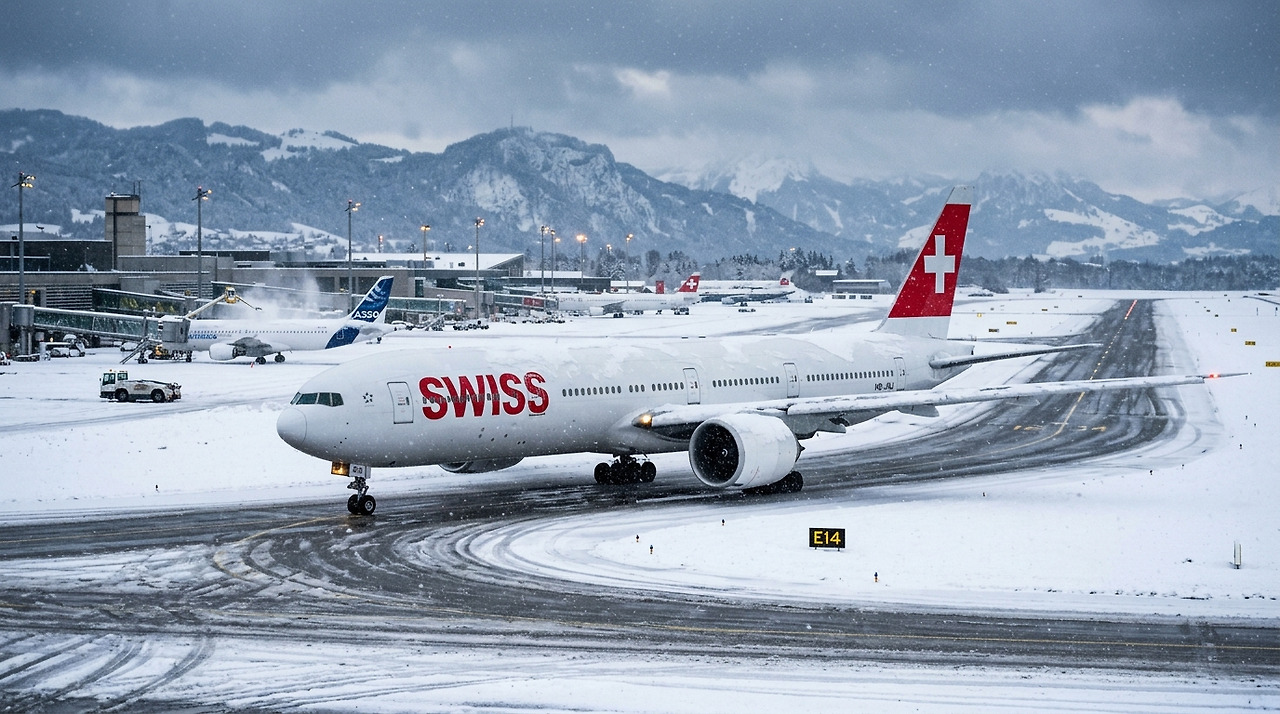
Picture a winter sky. You've likely seen something being sprayed from a plane before takeoff. If you thought it was just a cleaning job, think again. In reality, a desperate battle is underway to prevent fuel from freezing in mid-air. This isn't merely a technical problem—it's a matter of life and death. Every winter, airport refueling crews wage an intense fight against extreme cold.
What It Means When Fuel Freezes
"Fuel freezes? But oil doesn't freeze, right?" It's a fair question. Yet aviation fuel solidifies at far lower temperatures than regular gasoline. Jet A-1 fuel has a freeze point around minus 47 degrees Celsius, but at a cruising altitude of 12,000 meters, exterior temperatures drop below minus 56 degrees.
The real problem occurs in the tank itself. In the extreme cold of high altitude, microscopic water particles within the fuel crystallize into ice. As these ice crystals accumulate, they can completely block fuel supply lines—a catastrophic scenario.
Fuel crystallization caused by winter weather has actually caused several aviation incidents. Engine shutdown incidents during extreme-altitude flights have been documented, driving the aviation industry to mandate the use of fuel system icing inhibitors. There are countless incidents that would have ended in tragedy if the landing site had been any farther away.
The Rise of FSII: Principle and Purpose
The aviation industry's answer is Fuel System Icing Inhibitor, or FSII. The only product recognized internationally is Diethylene Glycol Monomethyl Ether (DiEGME). When this chemical is blended into jet fuel at a concentration of 0.10 to 0.15 percent, it fundamentally suppresses the formation of ice crystals.
FSII's mechanism is simple yet elegant. It forms chemical bonds with water molecules, preventing them from coalescing into large ice crystals. More precisely, it weakens the molecular bonds of water molecules at the molecular level, keeping them in a fine crystalline state. These microscopic crystals are small enough to pass through fuel filters without clogging the lines.
The U.S. FAA (Federal Aviation Administration) and Europe's EASA (European Union Aviation Safety Agency) mandate that all civil aviation operators use fuel containing FSII during winter months—typically November through March. This is not optional.
FSII originated in the 1960s when the U.S. Air Force was battling engine shutdowns in fighter jets. After more than 60 years of validation, FSII remains the only solution, precisely because aviation safety cannot be compromised.
Airport Refueling Infrastructure and Winter Preparation
Winter transforms airports' refueling centers entirely. Winter refueling demands more than twice the vigilance of summer operations. A single-degree temperature variation is sensitive enough to matter. Airports begin winter preparation checks around October each year.
All refueling tanks are equipped with advanced heating systems, and the long underground refueling pipeline networks are wrapped in thermal insulation. When temperatures drop below freezing, heat-tracing cables within the pipelines automatically activate to maintain consistent internal temperatures. Refueling truck fuel temperatures are monitored in real time by sensors, and below minus 10 degrees Celsius, strict safety protocols mandate that refueling speed be cut in half. This is necessary because fast refueling pressurizes the fuel, dropping the tank's internal temperature even further.
Consequently, winter aircraft refueling extends from 45 minutes in summer to over 70 minutes. This is one reason winter airport schedules become tighter than their summer counterparts.
Another critical component of the refueling system is "fuel topping"—filling the tank to capacity just before engine start, the final opportunity to verify FSII concentration. If the concentration deviates from specification at this stage, the flight is delayed.
FSII Requirements Vary by Aircraft Type—and Complexity Abounds
Not all aircraft require FSII the same way. Because different aircraft types—the Boeing 777, Airbus A380, Boeing 787—have different fuel system designs, FSII concentration standards vary slightly.
Airbus aircraft, particularly the A380, use exceptionally sensitive fuel filters requiring FSII concentration to be managed with extreme precision. The acceptable range is 0.10 to 0.15 percent. If concentration exceeds 0.16 percent, the filter's fine pores can become clogged, completely cutting off fuel supply. Conversely, if concentration drops below 0.09 percent, FSII's protective effect becomes insufficient, risking ice crystal formation. Maintaining precise blending within this narrow 0.06 percent window is the core responsibility of airport refueling teams.
Aviation fuel suppliers emphasize: "FSII concentration error of even 0.02 percent is unacceptable." Every batch is measured with precision analytical equipment. To this end, airport refueling centers are staffed with advanced measurement instruments and trained specialists who have completed international aviation safety certifications. During winter, around-the-clock monitoring is maintained through shift work.
Refueling Technology and Procedures in Extreme Cold
Winter refueling isn't simply pumping fuel into a tank. It involves several technical precautions.
First, static discharge prevention. If static electricity discharges inside the fuel tank, the fuel could ignite. Before refueling begins, the aircraft, refueling truck, and ground must all be electrically connected through a "grounding" procedure.
Second, even the refueling hose itself is swapped for winter use. Standard rubber hoses used in summer become brittle and prone to rupture below minus 40 degrees Celsius. Instead, specialized cold-resistant conductive hoses are used—flexible enough to function in extreme cold while maintaining electrical conductivity.
Third, an advanced technique called "fuel jetting" is employed. High-pressure nitrogen gas is injected into the fuel tank to suspend water molecules, flushing them out through the drain valve at the tank's bottom. This process minimizes water content in the fuel.
The complete winter refueling process unfolds as follows:
- Grounding: 3–5 minutes
- Connecting cold-resistant hoses: 2 minutes
- Verifying FSII concentration: 5 minutes
- Slow-speed fuel delivery: 45+ minutes
- Fuel jetting: 10 minutes
- Re-checking FSII concentration: 5 minutes
- Disconnecting grounding: 2 minutes
Total time exceeds 70 minutes.
The Hidden Cost of Winter Refueling
The refueling team's struggle is starkly reflected in costs. FSII additive pricing runs approximately 20 percent higher than pure jet fuel. At a baseline of $100 per barrel, FSII-enhanced jet fuel costs roughly $120 per barrel.
Add winter fuel heating, specialized equipment maintenance, and additional staffing costs, and the airport's total refueling expenses vary dramatically by season. Major international airports reportedly face winter refueling costs tens of millions of dollars higher annually than summer months. This additional expense persists across five months—November through March—every year.
More intriguingly, these costs flow through airlines and ultimately appear in passenger ticket prices. One reason winter airfares are higher than other seasons is here. On average, winter tickets cost 5 to 15 percent more than summer, partly due to these refueling surcharges.
Future Technology and Continuous Evolution
The aviation industry continues developing FSII alternatives: bio-based icing inhibitors, special refinery-processed fuels (hydrotreated esters and fatty acids, HEFA), and fuels based on emerging sustainable aviation fuel (SAF) standards.
Yet currently, every civil aviation operator worldwide depends on DiEGME-based FSII. Aviation safety remains paramount. New technologies require stringent certification from the FAA and EASA—a process typically involving over a decade of laboratory testing, ground trials, and controlled flight tests. Because aviation tolerates no compromise on safety, the adoption of unproven technology is virtually impossible.
For decades to come, winter airport refueling crews will continue their precise work, managing FSII concentration within a 0.15 percent margin. It may appear mundane, but it's actually critical work protecting millions of passengers' lives every winter.
The next time you fly in winter and see spray being applied to the aircraft before takeoff, recognize it not as a cleaning job but as a scientific, intense battle against extreme cold. Chemistry calibrated to 0.15 percent accuracy. Technology protecting your life in a minus 50-degree sky. The hidden effort of airport refueling professionals. Flight is not merely movement—it rests upon the dedication of countless scientists, technicians, and field specialists. As your aircraft climbs into the winter sky, simply knowing how complex and precise the cryogenic chemistry occurring in the fuel tank beneath your seat truly is will transform what flight means.
'✈ 비행과 공부 > 가볍게 읽는 글' 카테고리의 다른 글
| 8편 — 비행기는 비행 후 어떻게 준비될까: 공항 정비 센터의 72시간 (0) | 2026.05.20 |
|---|---|
| 7편 — 당신의 수하물은 어떻게 비행기에 오를까? 공항 수하물 처리 시스템의 24시간 (0) | 2026.05.18 |
| 겨울 활주로의 급유 전투 — 동결점강하제가 필요한 이유 (0) | 2026.05.17 |
| 하늘 위의 식당: 비행기 기내식 서빙 시스템의 과학 (0) | 2026.05.13 |
| 비행기 착륙 장치의 비밀: 랜딩기어 시스템의 엔지니어링 (0) | 2026.05.12 |


댓글