Publication Date: Based on January 5, 2024 Incident
Source: NTSB Investigation Report, FAA Public Notices
Executive Summary
On January 5, 2024, Alaska Airlines Flight 1282, a Boeing 737 MAX 9, experienced a catastrophic structural failure just 5 minutes and 30 seconds after takeoff from Portland when a door plug—a 5.3-foot-by-2.6-foot emergency exit panel—suddenly detached from the fuselage at 10,000 feet, causing rapid cabin depressurization. Fortunately, the captain's swift decision to execute an emergency descent, combined with the automatic oxygen system's activation and the aircraft's structural integrity, prevented any fatalities among the 177 occupants, though 7 sustained minor injuries. This incident exposed a critical convergence of manufacturing error, design deficiency, and organizational failure at Boeing—demonstrating how multiple defense layers can collapse simultaneously when production pressure supersedes safety discipline.
An Ordinary Evening, An Extraordinary Emergency
5:07 PM PST — January 5, 2024
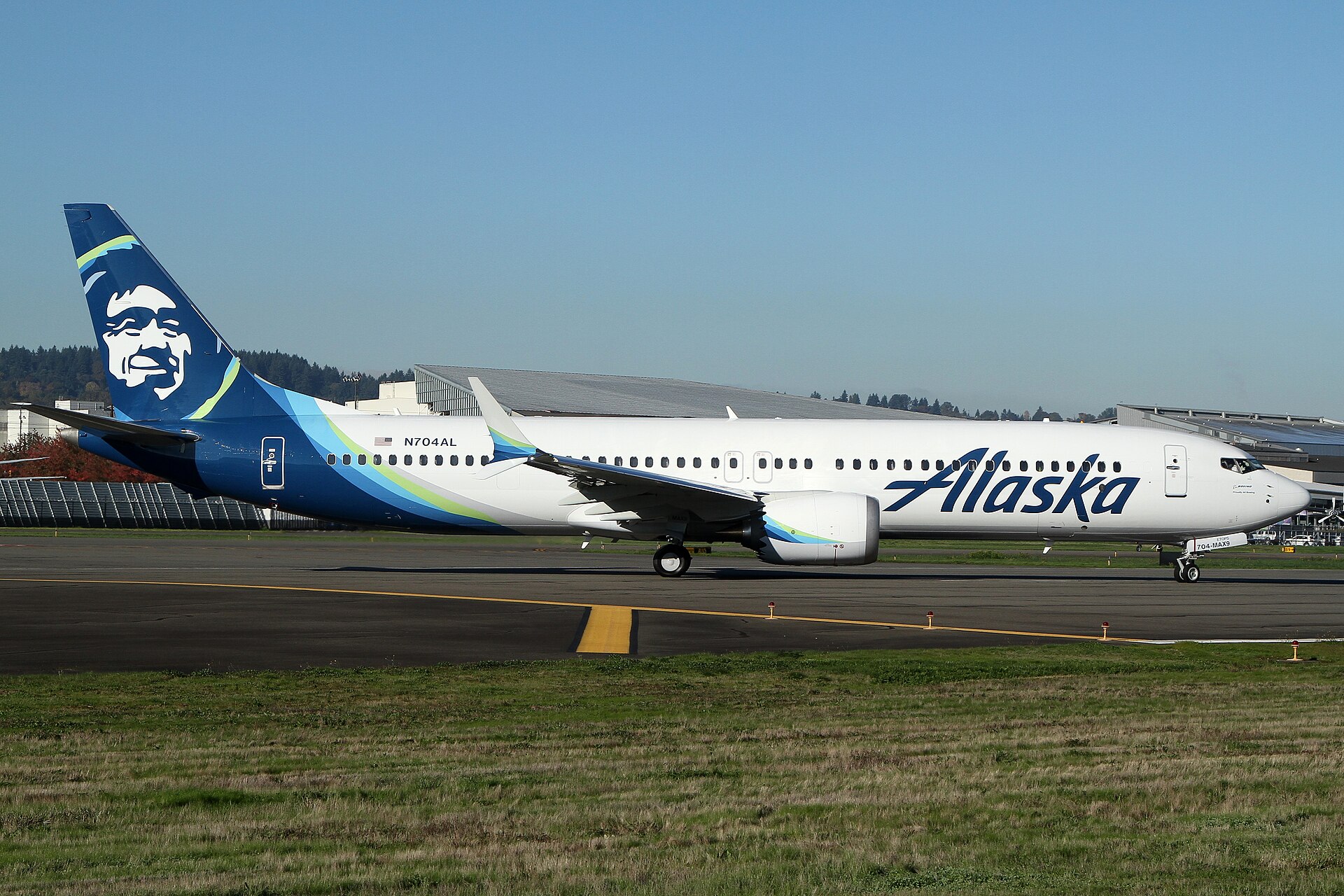
Portland International Airport. The sky was turning amber as evening approached. Alaska Airlines Flight 1282, a Boeing 737 MAX 9 (registration N704AL), held 171 passengers and 6 crew members—177 people bound for Honolulu on what should have been an uneventful evening flight.
The departure was routine. All procedures followed standard protocol. The aircraft met all airworthiness requirements. The crew was flawlessly prepared.
Yet perfection lasted only moments.
5 Minutes and 30 Seconds After Takeoff: "There's a Hole in the Plane!"
Altitude: 10,000 Feet
Approximately 5.5 minutes after takeoff, as the aircraft reached an altitude of roughly 10,000 feet (3,000 meters), cabin crew members transmitted a desperate message to the flight deck:
"There's a hole in the plane!"
The pilots, receiving that transmission, immediately understood something catastrophic had occurred. Within seconds, the reality proved far worse than anticipated.
The Door Plug Detaches
From the right side of the fuselage, between rows 9 and 10, a door plug—a reinforced emergency exit panel measuring approximately 5.3 feet by 2.6 feet—suddenly separated.
At 10,000 feet.
While airborne.
This door plug serves as an emergency escape route, to be used only in desperate circumstances. Under normal flight operations, it must remain secured. Multiple latches and fastening systems should lock it in place.
Yet on this flight, every fastening mechanism was in a disengaged state.
Rapid Cabin Depressurization: The Classic Aviation Emergency
Oxygen Masks and Emergency Declarations
As the door plug detached, the cabin experienced immediate decompression. The aircraft's automatic oxygen mask system activated instantly.
Oxygen masks dropped from overhead compartments above every passenger and crew member. The captain immediately recognized the severity of the situation and declared an emergency.
His decision was unambiguous: Immediate return to Portland.
The flight to Honolulu was cancelled. Now only one thing mattered—getting this aircraft safely to the ground.
Emergency Descent
The aircraft descended at a rate of 4,000 to 6,000 feet per minute—approximately twice the standard descent rate. This was an emergency descent executed by the book.
Inside the cabin, overwhelming anxiety spread. A gaping hole in the fuselage. Oxygen masks. The steepened angle of the aircraft. Screams and panic.
Yet this is precisely how aviation safety is supposed to function.
When one system fails, the next layer of defense must activate.
18 Minutes: The Time That Separated Life From Death
Injuries: Minor Only
Miraculously, there were no fatalities.
Some passengers sustained injuries, but all were minor in nature—primarily abrasions to the face and neck from oxygen mask contact during the emergency descent. This was nothing short of divine providence.
What if altitude had been higher?
What if the oxygen system had failed to activate?
What if the pilot's judgment had been delayed by even one minute?
Each "what if" would have signified catastrophe.
Portland Landing
Approximately 23 minutes after departure, the aircraft landed safely on runway 10 at Portland International Airport.
Despite structural damage, the landing was controlled and normal.
The pilot's expertise. The aircraft's design. And the intervention of fate.
When all three factors align, even seemingly impossible situations can end in survival.
The Real Problem: Why Did the Door Plug Open?
First Defense Layer Failure: Manufacturing Error
The NTSB investigation's conclusion was unambiguous. This was not a design flaw.
This was human error at the manufacturing facility.
During the installation of the door plug to the fuselage at Boeing's Spokane facility, four essential fastening bolts and spacers were omitted.
Standard installation procedure requires:
- Eight fastening components
- Four rotating latches
- Four locking bolts
All must be precisely installed.
Yet the work was not completed. And no one verified it.
Second Defense Layer Absent: Design Deficiency
The more critical failure came at the next stage.
The Boeing 737 MAX 9's door plug design contained no secondary locking mechanism.
In other words, if the primary latch mechanism failed completely, the aircraft possessed no backup system to prevent the plug from opening during flight.
This violates a fundamental principle of aviation safety.
Conventionally, emergency exit doors follow this design philosophy:
The primary locking mechanism must fail safely. Even if it completely malfunctions, the door shall remain secured.
Yet the 737 MAX 9's door plug lacked this backup.
When the first defense layer (manufacturing) failed, and the second defense layer (design backup) didn't exist, catastrophe ensued.
Third Defense Layer Weakness: Quality Control System
Before aircraft delivery, a final inspection should have verified the door plug's fastening status.
Yet a critical problem existed.
Visually confirming every bolt within the individual door plug was physically impossible given the design's accessibility limitations.
The design itself prevented inspectors from seeing all fastening points.
This should have been foreseen during the design phase.
Organizational Culture Failure: Production Speed Versus Safety
The Shadow of the 737 MAX
By January 2024, Boeing was trying to escape the specter of the past.
The 737 MAX had been grounded for approximately 20 months following two fatal accidents in 2018 and 2019. Trust in the 737 MAX had evaporated.
After the grounding was lifted in 2020, Boeing faced massive pressure to process accumulated orders. Production rates needed to increase dramatically.
The Pressure to Recover Schedule
What happened during this acceleration?
Adequate workforce expansion? Sufficient training? Quality control investment?
None of these. Production targets increased without corresponding support.
The NTSB investigation suggests:
Boeing was rapidly increasing production rates to recover from 737 MAX scheduling delays. Without adequate workforce expansion or comprehensive training, production goals alone were prioritized, and FAA oversight alone proved insufficient.
This represents organizational culture failure.
A culture prioritizing speed over safety. A structure prioritizing numbers over people.
The worker who installed the door plug cannot be blamed. That employee likely faced insufficient training combined with overwhelming production pressure.
Responsibility flows upward.
Why This Became a Catastrophe: Sequential Defense Layer Collapse
The Swiss Cheese Model
Aviation safety operates under the "Swiss Cheese Model" concept.
Imagine each defense layer (design, manufacturing, inspection, training, etc.) as a slice of Swiss cheese. Each slice contains holes—imperfections are inevitable.
One slice with holes poses no problem. Another slice behind it catches what the first misses.
But when all holes align perfectly?
Catastrophe.
For Alaska Airlines Flight 1282:
Layer 1 (Manufacturing): Four bolts and spacers omitted
↓ (Expected: inspection would catch this)
Layer 2 (Design Backup): No secondary locking mechanism
↓ (Expected: emergency protection would activate)
Layer 3 (Quality Control): Design prevented inspection
↓ (Expected: final verification would confirm)
Catastrophe
Every hole aligned perfectly.
What Went Right: Why This Wasn't a Mass Casualty Event
Defense Layer #1: The Captain's Rapid Decision
Upon receiving the emergency notification, Alaska Airlines Flight 1282's captain immediately recognized the severity and declared an emergency descent.
This decision saved lives.
When rapid decompression occurs at 10,000 feet, oxygen reserves are finite. The faster the descent, the longer each passenger can sustain consciousness.
The captain calculated this precisely (consciously or instinctively).
Defense Layer #2: The Automatic Oxygen System
The moment cabin depressurization occurred, the automatic oxygen mask system activated immediately.
This device has been legally mandatory since the 1970s.
Had it not been mandatory? Many passengers would have been too confused, too panicked to locate masks independently.
Every oxygen molecule not delivered might have meant one additional life lost.
Defense Layer #3: Aircraft Structural Design
Despite damage from the door plug loss, the aircraft maintained flight capability.
This resulted from design principles. Modern aircraft are engineered with structural margin—redundancy built into their design to tolerate partial damage.
Had this been a 1960s-era aircraft?
The story would have ended differently.
The "What Ifs": Standing Back From the Precipice
We must confront not what fortunately occurred, but what could have happened.
If Altitude Had Been Higher?
What if the door plug had separated at 35,000 feet?
Oxygen mask oxygen supply is limited—typically providing approximately 12-15 minutes of supplemental oxygen.
If descent from 35,000 feet to the safe altitude of 10,000 feet required 15 minutes?
As passengers began losing consciousness from oxygen deprivation, how would the pilot have maintained aircraft control?
If Discovery Had Been Later?
What if cabin crew had reported the situation 30 seconds later?
What if pilot judgment had been delayed by one minute?
Ten thousand feet represents a critical threshold. Above it, danger increases exponentially. Below it, safety margins expand.
Had the aircraft been at one minute's higher altitude when the descent began, the outcome might have been catastrophically different.
If It Had Been the Flight Deck Door Instead?
Had the regular flight deck door opened during cruise?
While the flight deck enjoys superior protection, opening that door would still create extreme danger.
Additionally, unauthorized personnel could have gained access to the cockpit.
Systemic Failure: The Organizational Problem
Boeing's Quality Control System
The NTSB investigation makes explicit findings:
This was not an isolated incident.
Multiple Boeing 737 MAX 9 aircraft from the Spokane facility showed similar door plug deficiencies. Patterns emerged in the assembly process.
This indicates systemic problems, not individual error:
- Were assembly procedures unclear?
- Were inspection standards inadequate?
- Was oversight absent?
All of the above.
FAA Oversight Absence
The FAA bears responsibility for overseeing Boeing.
Yet the fact that aircraft N704AL—bearing this critical defect—received airworthiness certification suggests what?
If FAA oversight had been adequate, this aircraft would never have been approved for flight.
Following the incident, the FAA dramatically enhanced its Boeing oversight. But this represents reactive response.
Immediate Actions: Emergency Inspection of All 737 MAX 9s
FAA's Emergency Directive
On the day of the incident, the FAA issued an immediate inspection mandate for every Boeing 737 MAX 9 aircraft.
This represented unprecedented responsive action.
Airlines received the following directives:
- Verify the latch status on all door plugs
- Install temporary supplemental locking hardware as needed
- Conduct mandatory periodic inspections until Boeing provides permanent modifications
This ranked among the fastest regulatory responses in aviation history.
Permanent Changes: Boeing's Response and Design Improvements
February Design Modifications
Boeing presented procedures in February 2024 for installing new door plug assemblies on all 737 MAX 9 aircraft.
Key improvements:
- New secondary locking mechanism added — prevents plug opening even if primary latches fail
- Enhanced assembly design — all fastening components now visually verifiable
- Strengthened inspection procedures — automated inspection systems implemented
Each aircraft required approximately 4-6 hours of modification time.
Production Suspension
Boeing temporarily suspended new 737 MAX 9 production.
This represented a significant business decision because:
- Hundreds of aircraft were already on order
- Each schedule delay meant hundreds of millions in losses
- Yet Boeing prioritized quality
At least ostensibly.
Deeper Lessons: The Importance of Organizational Culture
Beyond Design and Manufacturing
When analyzing aviation accidents, we often state: "A bolt was missing" or "Welding failed."
But the more fundamental question is:
Why did the system not catch that failure?
For Alaska Airlines Flight 1282:
- Insufficient training combined with excessive production targets
- Inadequate quality control systems
- Omission of "secondary defense layer" during design phase
All stemmed from organizational culture.
If a company claims "safety is priority number one," yet actually operates where "schedule is priority one," the outcome becomes inevitable.
Aviation Safety's Layered Defense
Aviation safety comprises not a single layer.
It consists of multiple independent defense layers:
- Design — Engineer so problems cannot occur
- Manufacturing — Implement design intent precisely
- Inspection — Verify defects don't leave the facility
- Operations — Respond rapidly if problems emerge
- Organizational Culture — Foundation underlying all others
For Alaska Airlines Flight 1282, layers 1, 3, and 5 failed.
Had layer 2 also failed completely?
Catastrophe would have been inevitable.
Was This Luck?
Moments of Fate
- 10,000-foot altitude (higher would have been more dangerous)
- Emergency descent rate (perfect judgment)
- Automatic oxygen system (functioned)
- Captain's rapid response (golden seconds)
Rather than coincidence, this represented multiple safety systems working in concert.
Therefore, this was not luck.
This was design.
Aviation safety's fundamental philosophy states:
No single failure should result in catastrophe.
Alaska Airlines Flight 1282 demonstrates how this philosophy saves lives.
NTSB Safety Recommendations
Recommendations for Boeing
- Add secondary safety mechanisms to door plug assemblies
- Implement automated inspection systems to verify all fastening components are properly installed
- Improve assembly procedures to enable visual verification of all critical elements
Recommendations for the FAA
- Conduct emergency inspections of all aircraft containing 737 MAX 9 door plugs
- Perform enhanced oversight of Boeing's quality control systems
- Conduct comprehensive review of similar designs in other aircraft types
Lessons for the Industry
This incident proved:
Design deficiency + Manufacturing error + Oversight failure = Potential catastrophe
Every airline and manufacturer must internalize this lesson.
The True Meaning of Aviation Safety
One Person Saved 177 Lives
Had Alaska Airlines Flight 1282's captain not reacted with rapid judgment?
The 177 lives aboard might have ended very differently.
That is aviation safety.
It is not merely "nobody dies."
It means people survive even under the worst conceivable circumstances.
The Invisible Dedication
When you board an aircraft, you see:
- Flight attendants
- Pilots
- The airplane itself
But what remains invisible is more important:
- Design engineers' commitment
- Inspectors' vigilance
- Regulators' oversight
- Organizations' dedication to safety
When all work together, aircraft are safe.
Conclusion: Perfection Is Impossible, But Safety Is Non-Negotiable
Alaska Airlines Flight 1282 was a tragedy narrowly averted.
This situation could have claimed 177 lives.
Yet it also demonstrated human resilience and the power of systems.
Manufacturing error occurred. Design deficiency existed. Oversight failed.
Nevertheless, 177 people survived.
The Path Forward
Boeing and the FAA have embraced these lessons:
- Secondary systems added to designs
- Manufacturing processes improved
- Inspection automation deployed
- Oversight strengthened
Yet the most critical change must be organizational culture.
Is safety truly the first priority?
Or do schedules and profits supersede safety?
Only organizations answering "yes" to the first question will achieve genuine safety.
Incident Statistics
| Incident Time | January 5, 2024, 5:07 PM PST |
| Aircraft Type | Boeing 737 MAX 9 |
| Registration | N704AL |
| Total Occupants | 171 passengers + 6 crew (177 total) |
| Casualties | 0 fatalities / 7 minor injuries |
| Incident Altitude | Approximately 10,000 feet |
| Descent Rate | 4,000-6,000 feet per minute |
| Time to Landing | Approximately 18 minutes |
| Landing Airport | Portland International Airport |


댓글